
Regional Queensland
Regional recruitment specialist for Queensland employers, from Cairns to Toowoomba and Mount Isa. See how hard each region is to hire in, and how we help.
Hire Australia is a regional recruitment specialist. We help residential aged care homes, home care providers and hospitals across regional Australia hire aged care and personal care workers and assistants in nursing, along with team leaders and care coordinators. Screening, the shift pattern and the travel between clients are part of the search from the first conversation.
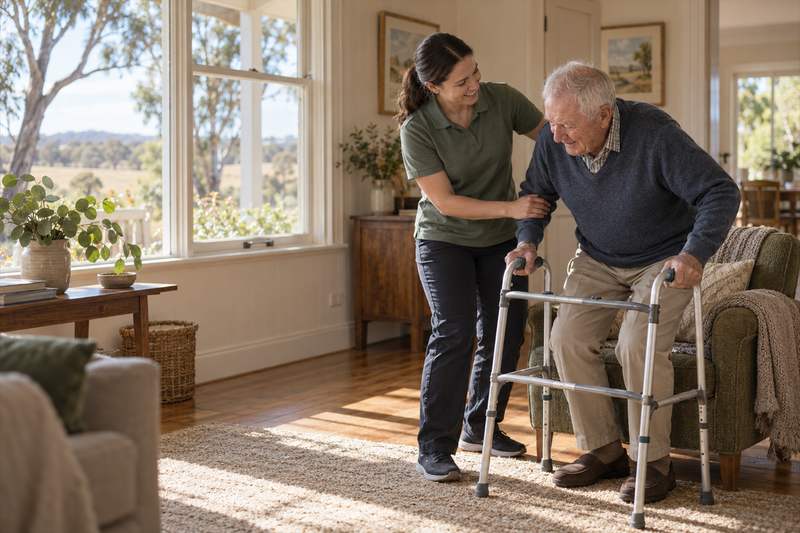
Aged care is one of the largest and fastest-growing workforces in the country, and much of the hiring happens outside the major cities.
Aged care workers help older people with personal care, mobility, meals and daily activities, in their own home or in an aged care home.4 Personal care workers and assistants in nursing do similar work in aged care homes and hospitals, under the direction of a nurse.
Relevant qualifications include CHC33021 Certificate III in Individual Support, which replaced CHC33015; experienced workers may hold an earlier relevant qualification.5 Senior and team leader roles may ask for CHC43015 Certificate IV in Ageing Support.6 The new Aged Care Act started on 1 November 2025,7 and screening rules for every aged care worker are national, as the table below shows.
The aged care rule is national: every aged care worker needs a police certificate no older than 3 years that does not record certain offences, or an NDIS worker screening check. The registered provider must assess the police certificate, and the NDIS check is recognised in aged care.8 A worker who chooses the NDIS check gets it from the unit in their state or territory, and it is valid for up to 5 years.9
Screening for aged care workers, and the unit that issues the NDIS worker screening check in each state and territory, as published by each issuer on 1 November 2026.
| State or territory | Aged care screening | NDIS worker screening clearance: issuer |
|---|---|---|
| All states and territories | Police certificate no older than 3 years, or an NDIS worker screening check8 | One national check, recognised in aged care9 |
| New South Wales | National rule, as above | Office of the Children's Guardian (NDIS Worker Check)10 |
| Victoria | National rule, as above | Victorian Government11 |
| Queensland | National rule, as above | Queensland Government (a blue card is also needed for work with children with disability)12 |
| South Australia | National rule, as above | Department of Human Services13 |
| Western Australia | National rule, as above | Department of Communities14 |
| Tasmania | National rule, as above | Department of Justice, as part of registration to work with vulnerable people15 |
| Northern Territory | National rule, as above | SAFE NT, NT Police, Fire and Emergency Services16 |
| Australian Capital Territory | National rule, as above | Access Canberra, in addition to Working with Vulnerable People registration17 |
The award depends on the setting. In residential aged care, the Aged Care Award 2010 sets minimums for direct care employees from 1 July 2026 of $1,307.80 a week at level 2, $1,376.70 ($36.23 an hour) at level 3 for a qualified worker, and $1,431.80 at level 4.18
In home care, the Social, Community, Home Care and Disability Services Industry Award 2010 sets $1,376.70 a week for a home care employee in aged care at level 3, from 1 July 2026.19 In hospitals and other health settings outside aged care, the Nurses Award 2020 sets $1,119.10 a week for an experienced assistant in nursing, from 1 July 2026.20
Aged and disabled carers had median full-time earnings of $1,761 a week, and nursing support and personal care workers $1,612, in May 2025, nationally.4 No regional pay series exists for these occupations, so we talk with you about the rate, shift penalties and travel allowances that will compete for your location.
New South Wales carries the most aged and disabled carer job ads, followed by Queensland and Victoria. Across Australia there were 3,621 carer ads and 1,527 nursing support and personal care worker ads a month in the three months to September 2026, close to a year earlier.1
Both groups are advertised outside the major cities far more than most jobs: 44% of carer ads and 49% of nursing support and personal care worker ads were for regional areas, against 29% of all ads.2 The carer group also includes disability support workers.
Online job ads a month for aged and disabled carers and for nursing support and personal care workers by state (three-month average to September 2026), and each state's share of aged and disabled carers employed (February 2026).1,4
| State or territory | Aged and disabled carers: ads a month | Nursing support and personal care workers: ads a month | Share of carers employed |
|---|---|---|---|
| New South Wales | 1,1861 | 527 | 27.4%4 |
| Queensland | 927 | 311 | 23% |
| Victoria | 832 | 394 | 24.5% |
| South Australia | 311 | 113 | 9.8% |
| Western Australia | 216 | 109 | 10.1% |
| Tasmania | 68 | 40 | 3% |
| Australian Capital Territory | 47 | 21 | 1.2% |
| Northern Territory | 35 | 14 | 1% |
Shortage ratings split this workforce. Aged or Disabled Carer is rated in shortage nationally; Personal Care Assistant and Nursing Support Worker are not, though individual homes and hospitals can still find them hard to fill.
National ratings on the 2026 shortage list, ANZSCO 2022 6-digit occupations. In shortage means rated S (shortage) or R (regional shortage).3
| Occupation (ANZSCO 2022) | 2026 national rating |
|---|---|
| Aged or Disabled Carer (423111) | In shortage3 |
| Personal Care Assistant (423313) | Not in shortage |
| Nursing Support Worker (423312) | Not in shortage |
| Hospital Orderly (423311) | Not in shortage |
Tell us the setting first: a residential home, home care in people's own homes, or a hospital ward. Then the level, from a newly certified care worker to a team leader or care coordinator.
The practical details shape who will apply: the shift pattern and night work, driving between clients and whether a car is supplied, medication assistance, dementia or palliative care experience, and part-time or full-time hours.
You make the hiring decision and employ the person directly. We handle the search and the organising in between.
Only 40% of aged and disabled carers work full-time hours,4 so tell us the hours you can offer. Tell us too about driving between clients in home care roles. We start with workers who already live in or have ties to your region, then widen the search.
Tell us early about minimum hours, travel allowances, a vehicle and any help with housing. We raise them in the first conversation.
If the right person needs a visa or sponsorship, our sister business Australian Immigration Agency can advise.
Register with Hire Australia and tell us your qualification, your screening, the settings you have worked in and where you would like to work. We will talk with you about roles that fit.
Tell us the role, the setting, the location and the shifts.
Employers pay nothing until the successful candidate has started and stayed two months. Candidates never pay for recruitment.
A FEW PRACTICAL QUESTIONS
Every aged care worker needs a police certificate no older than 3 years that does not record certain offences, or an NDIS worker screening check, and the registered provider assesses the police certificate.8 The rule is the same in every state. Hire Australia builds the check into the brief and asks candidates which they hold; you complete the formal screening as the employer.
From 1 July 2026 the Aged Care Award 2010 sets $1,376.70 a week for a qualified direct care employee at level 3, and the home care award sets $1,376.70 for a home care employee in aged care at level 3.18,19 Aged and disabled carers' national median full-time pay was $1,761 a week in May 2025.4 Hire Australia talks through your pay range early.
Partly. On the 2026 list, Aged or Disabled Carer is rated in shortage nationally, while Personal Care Assistant and Nursing Support Worker are not.3 In the three months to September 2026, 44% of aged and disabled carer job ads were for regional areas.2 Hire Australia plans regional aged care searches around your shifts and start date.
Yes. Hire Australia recruits assistants in nursing and personal care workers for aged care homes and hospitals, as well as home care workers and team leaders. Outside aged care, the Nurses Award 2020 sets $1,119.10 a week for an experienced assistant in nursing from 1 July 2026.20 Tell us the setting and the shifts, and we search for people with matching experience.
Employers pay nothing until the successful candidate has started and stayed two months. Candidates never pay for recruitment. You employ the person directly, and we agree the terms with you in writing before the search begins. The fee terms are the same whether Hire Australia recruits a personal care worker or an aged care team leader.
No. Hire Australia recruits people you employ directly, in permanent roles. We don’t supply labour hire or temps, and candidates never work on our payroll. We search for and screen people for your vacancy, introduce the ones who fit, and you make the offer and employ them. That keeps the working relationship between you and your new employee from day one.