
Regional Queensland
Regional recruitment specialist for Queensland employers, from Cairns to Toowoomba and Mount Isa. See how hard each region is to hire in, and how we help.
Hire Australia is a regional recruitment specialist. We help builders, civil and commercial contractors, joinery manufacturers, councils and housing providers across Australia hire qualified carpenters and joiners, from framers and fit-out carpenters to formworkers and site leading hands. We work out with you whether the role needs a licence in your state, because for carpentry that depends on who holds the contract.
Carpenters and joiners are in national shortage. Ads for them have eased over the past year, but the shortage rating stands.
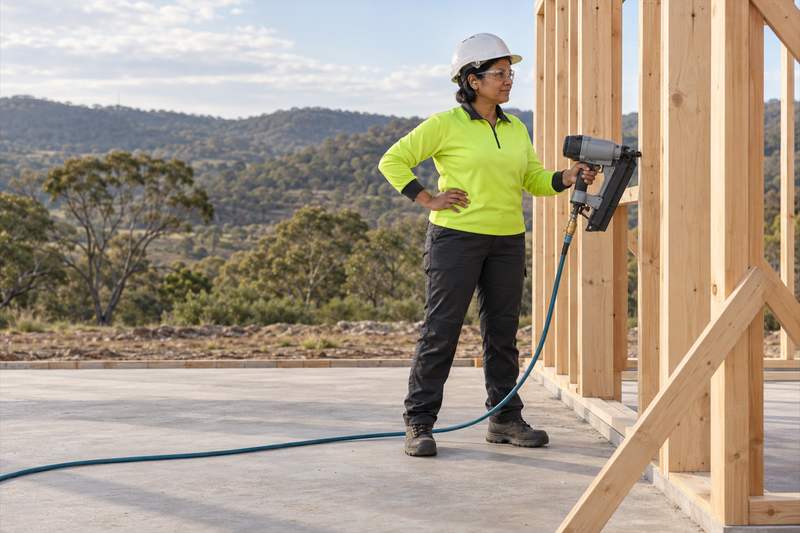
Carpenters and joiners study drawings, erect framework, panelised systems and roof framing, lay sub-floors and floorboards, fit cladding and door and window frames, and assemble wood into structures and fittings; many also build concrete formwork.5
The national trade qualification is CPC30326 Certificate III in Carpentry, a new release in September 2026.6 Every carpenter on a construction site also needs a construction induction card, the white card.7
In most states an employed carpenter needs no individual licence. The licence or registration attaches to contracting for building work above a set value, or to supervising it, and each state sets its own threshold.
Licence or registration for carpentry and building work, by state and territory, as published by each regulator on 1 November 2026.
| State or territory | Licence or registration | When it applies |
|---|---|---|
| Queensland | QBCC licence to contract for building work valued over $3,3008 | Employees of a licensed contractor usually need none; supervisors and nominees do8 |
| New South Wales | Contractor licence for residential building or trade work, including carpentry, over $5,0009 | A qualified supervisor certificate is the licence type for supervising the work9 |
| Victoria | Registration as a Domestic Builder (limited to carpentry) to contract for carpentry on homes10 | Required for a major domestic building contract, over $10,00010 |
| South Australia | Building work contractor's licence for the business doing the work11 | Carpenters doing specified building work need $10,000 in net assets, or a restricted subcontractor licence11 |
| Western Australia | Building contractor registration for the business, for permit work within the Building Services Board's jurisdiction12 | Applies to work valued at $20,000 or more, or $50,000 or more for a Class 10a building such as a shed; an employed carpenter isn't the registered party12 |
| Tasmania | Carpenter is not a licensed occupation; builder licences cover those running building work13,14 | A Certificate III in carpentry counts towards a builder licence's experience14 |
| Northern Territory | Registration as a residential building contractor15 | Applies to residential work valued at $25,000 or above15 |
| Australian Capital Territory | No licence: carpenters don't currently need one16 | Builders do need a licence16 |
| All states and territories | Construction induction white card before starting work on a construction site7 | Ask to see it at interview |
Where the Building and Construction General On-site Award 2020 covers the role, a qualified carpenter (Level 3, CW/ECW 3) on weekly hire must be paid at least $1,214.04 a week on residential work and $1,227.47 on other building work, from 1 July 2026, including the industry and tool allowances.17 The award covers on-site building, civil and engineering construction work.18
Market pay is well above those minimums. Carpenters and joiners had median full-time earnings of $1,760 a week, or $45 an hour, in May 2025, nationally.4 Site allowances, travel and overtime vary by project, so we agree the full package with you before we approach anyone.
Queensland and New South Wales carry the most carpenter job ads. Across Australia, ads eased from 1,137 to 1,041 a month in the year to September 2026, although the trade stays in shortage.1,2 Regional areas held 317 of the ads with a location.3
Online job ads for carpenters and joiners by state (three-month average to September 2026 and a year earlier) and each state's share of the trade's employment (February 2026).2,4
Tell us the work: housing, commercial fit-out, civil formwork, bridges or joinery, and whether the person frames, fits out, builds formwork or makes components in a workshop. Say whether they will supervise others or run sites, and whether your state needs them to hold a licence or registration for that.
Then the practical details carpenters ask about: the projects lined up, travel between sites, the hours and rostered days off, tools and a vehicle, and the rate and site allowances.
You make the hiring decision and employ the person directly. We handle the search and the organising in between.
Tell us the projects ahead, where they are and any travel or accommodation they involve. We describe the project pipeline, the travel and the accommodation in the first conversation.
We start with carpenters who already live in your region, then widen the search to those ready to move. Tell us about relocation help or housing, and we will put it in front of candidates.
If the right person needs a visa or sponsorship, our sister business Australian Immigration Agency can advise.
Register with Hire Australia and tell us the carpentry you do, your qualification and tickets, any licence you hold and where you would like to work. We will talk with you about regional roles that fit.
Tell us the projects, the location and when you need the carpenter to start.
Employers pay nothing until the successful candidate has started and stayed two months. Candidates never pay for recruitment.
A FEW PRACTICAL QUESTIONS
Usually not. In Queensland most employees of a licensed contractor need no licence, and the ACT says carpenters don't currently need one; licences in most states attach to contracting above a set value, such as $5,000 in New South Wales.8,9,16 Hire Australia checks whether your role includes contracting or supervision that needs one.
Where the Building and Construction General On-site Award 2020 covers the role, a qualified carpenter on weekly hire must be paid at least $1,214.04 a week on residential work and $1,227.47 on other building work from 1 July 2026.17 The median was $1,760 a week in May 2025.4 Hire Australia agrees the rate with you first.
Carpenter and Joiner is rated in national shortage for 2026,1 even though ads eased to 1,041 a month in the three months to September 2026, 317 of them for regional areas.2,3 Hire Australia starts regional carpentry searches with people who already live near your projects.
Yes. Joiner is rated in national shortage for 2026 in its own right,1 and building concrete formwork is part of the carpentry trade.5 Hire Australia recruits workshop joiners, fit-out carpenters and formworkers for permanent roles, and asks about the materials, machinery and project types they know.
Employers pay nothing until the successful candidate has started and stayed two months. Candidates never pay for recruitment. You employ the person directly, and we agree the terms with you in writing before the search begins. The fee terms are the same whether Hire Australia recruits a framer for a builder or a leading hand for a civil contractor.
No. Hire Australia recruits people you employ directly, in permanent roles. We don’t supply labour hire or temps, and candidates never work on our payroll. We search for and screen people for your vacancy, introduce the ones who fit, and you make the offer and employ them. That keeps the working relationship between you and your new employee from day one.