
Regional Queensland
Regional recruitment specialist for Queensland employers, from Cairns to Toowoomba and Mount Isa. See how hard each region is to hire in, and how we help.
Hire Australia is a regional recruitment specialist. We help private dental practices, dental groups, community dental services and Aboriginal health services across regional Australia hire dentists, from graduates to experienced general dentists and dental specialists. Registration, the X-ray licence your state requires and the realities of a regional practice are part of the search from the first conversation.
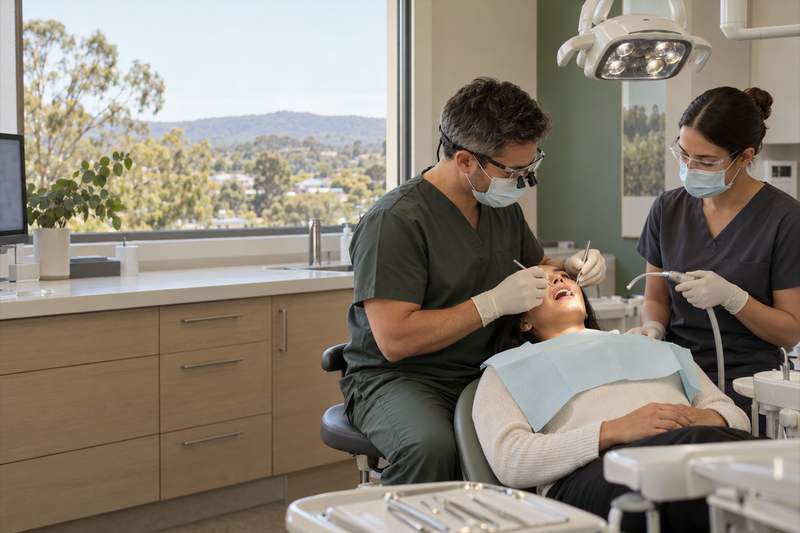
Dentists are rated in shortage, and a third of the job ads for dental practitioners are outside the major cities.
Dentists diagnose and treat dental disease, injuries, decay and malformations of the teeth, gums and other structures of the mouth, using surgery and other techniques. They also lead the dental team of hygienists, therapists and dental assistants.4
Every dentist must be registered with the Dental Board of Australia, and registration is national.5 A dentist with further training can also hold specialist registration in one of 13 recognised specialties, such as orthodontics, endodontics, periodontics or oral and maxillofacial surgery. The public register shows each dentist's specialty.6 At 30 June 2026, 21,840 practitioners were registered in the dentist division alone.7
Registration is national, but the licence to take dental X-rays is set by each state and territory. New South Wales removed the user licence for most dental X-rays on 1 December 2025, while Victoria still requires a use licence for every unit type.
Dental X-ray (radiation use) licensing for registered dentists, as published by each state or territory regulator, read on 1 November 2026. Registration with the Dental Board of Australia applies in every state.
| State or territory | Dental X-ray licence for a registered dentist |
|---|---|
| New South Wales | No user licence for intra-oral, OPG or lateral cephalometric X-rays since 1 December 2025; a licence is needed for cone beam CT8,9 |
| Victoria | Use licence; Ahpra registration for intra-oral units, plus a recognised course or degree for panoramic and cephalometric units; 3D (cone beam) units also need DEN4 and DEN5 training within the last 12 months10 |
| Queensland | Deemed to hold a use licence for intra-oral X-rays; other dental X-ray equipment needs a use licence11 |
| Western Australia | No licence for intra-oral, OPG or lateral cephalometric X-rays; cone beam CT needs a Radiological Council licence, with specialist dentomaxillofacial radiology registration or a recognised CBCT course12,13 |
| South Australia | Radiation licence from the EPA to operate X-ray apparatus14 |
| Tasmania | Licence under the Radiation Protection Act 2005 to use a radiation source15 |
| Northern Territory | Licence needed; Ahpra registration covers intra-oral X-rays, and OPG and cone beam CT need evidence of training16 |
| Australian Capital Territory | Radiation licence; Ahpra registration for general dental X-rays, plus radiation safety training for 3D and cone beam CT units17 |
The Health Professionals and Support Services Award covers employers that deliver dental services and their health professional employees, apart from medical practitioners and anyone covered by a state public sector award.18 Its list of professions doesn't name dentists, so where the award covers the role a dentist is classified by the AQF level of the profession's standard entry qualification.18 A first-year dentist's full-time minimum is $1,308.80 a week at AQF level 7, or $1,444.90 at AQF level 9, from 1 October 2026.18
Market pay sits well above the award floor. Dental practitioners, a group that includes dental specialists, had median full-time earnings of $3,232 a week, or $85 an hour, in May 2025, nationally.4 No regional pay series exists for dentists, so we talk with you about the salary, relocation help and housing that will compete for your location.
Health Professional employee Level 1, full-time minimum weekly rates by AQF level and years of experience, from the first full pay period on or after 1 October 2026.18
| AQF level of the entry qualification | 1st year a week | 4th to 6th year a week | 7th year and after a week |
|---|---|---|---|
| Level 7 | $1,308.8018 | $1,565.30 | $1,689.50 |
| Level 9 | $1,444.90 | $1,659.30 | $1,755.00 |
Queensland and New South Wales carry the most job ads for dental practitioners. Ads fell in New South Wales over the year to September 2026, from 152 to 127 a month, and rose in Victoria and Western Australia.2
Regional areas held steady at 149 ads a month, against 152 a year earlier.3 Most registered dentists practise in New South Wales, Victoria and Queensland.7
Online job ads for dental practitioners by state and territory (three-month average to September 2026 and a year earlier), and practitioners registered in the dentist division only at 30 June 2026.2,7
Open a role type for its rating, the checks that matter and what to put in your brief.
Dentists for private practices, dental groups and regional clinics.
Orthodontists, endodontists, periodontists, oral surgeons and other specialists.
Dentists for state, community and Aboriginal community controlled dental services.
Start with the practice: its location, patient base, number of chairs and the dentists already working there. Then the level you need, from a graduate who wants mentoring to an experienced dentist who can run the clinical side, or a specialist for referred patients.
The details that decide a regional move matter just as much: the days and hours, any after-hours roster, the X-ray and imaging equipment, the support from hygienists, therapists and dental assistants, and help with relocation and housing.
You make the hiring decision and employ the person directly. We handle the search and the organising in between.
We raise the practical side of a move with every dentist we approach: the caseload, the referral network, housing and the distance from family. Tell us early what you offer for relocation costs, professional development and mentoring, so we can put it in front of candidates from the first conversation.
We search first among dentists who already live in or have ties to your region, then among those planning a move. A dentist moving from interstate keeps their national registration but may need your state's X-ray licence before taking radiographs.10 If the right person needs a visa or sponsorship, our sister business Australian Immigration Agency can advise.
Register with Hire Australia and tell us your registration, any specialty, the work you enjoy and where you would like to practise. Graduate and experienced dentists are welcome, and we will talk with you about roles that fit.
Tell us the role, the practice, the location and your start date.
Employers pay nothing until the successful candidate has started and stayed two months. Candidates never pay for recruitment.
A FEW PRACTICAL QUESTIONS
No. Registration with the Dental Board of Australia is national, so one registration covers every state and territory.5 The licence to take dental X-rays is set by each state: Victoria requires a use licence, while New South Wales exempts registered dentists for most dental X-rays.8,10 Hire Australia raises your state's rule with dentists moving from interstate.
Where the Health Professionals and Support Services Award covers the role, a first-year dentist's minimum is $1,308.80 a week at AQF level 7, or $1,444.90 at AQF level 9, from 1 October 2026.18 Market pay is far higher: dental practitioners' national median was $3,232 a week in May 2025.4 Hire Australia talks through your pay range early.
Dentist is rated in shortage for 2026.1 Job ads for dental practitioners averaged 503 a month in the three months to September 2026, and 149 of them were for regional areas.2,3 Hire Australia plans each regional dentist search around your start date, the practice and the support you can offer.
We ask every dentist about their registration, any specialty and the X-ray licence they hold, and we pass on what they tell us. The public register of practitioners shows each dentist's registration and specialty.6 Hire Australia leaves the formal registration, licence and reference checks with you as the employer.
Employers pay nothing until the successful candidate has started and stayed two months. Candidates never pay for recruitment. You employ the person directly, and we agree the terms with you in writing before the search begins. The fee terms are the same whether Hire Australia recruits a graduate dentist or a dental specialist.
No. Hire Australia recruits people you employ directly, in permanent roles. We don’t supply labour hire or temps, and candidates never work on our payroll. We search for and screen people for your vacancy, introduce the ones who fit, and you make the offer and employ them. That keeps the working relationship between you and your new employee from day one.