
Regional Queensland
Regional recruitment specialist for Queensland employers, from Cairns to Toowoomba and Mount Isa. See how hard each region is to hire in, and how we help.
Hire Australia is a regional recruitment specialist. We help electrical contractors, mines, manufacturers, councils and service businesses across Australia hire licensed electricians, from tradespeople ready to work on their own to leading hands and supervisors. Every search starts with the licence your state requires and the work the electrician will actually do.
Electricians are in national shortage and job ads for them rose over the past year, so a regional search needs a clear brief and an early start.
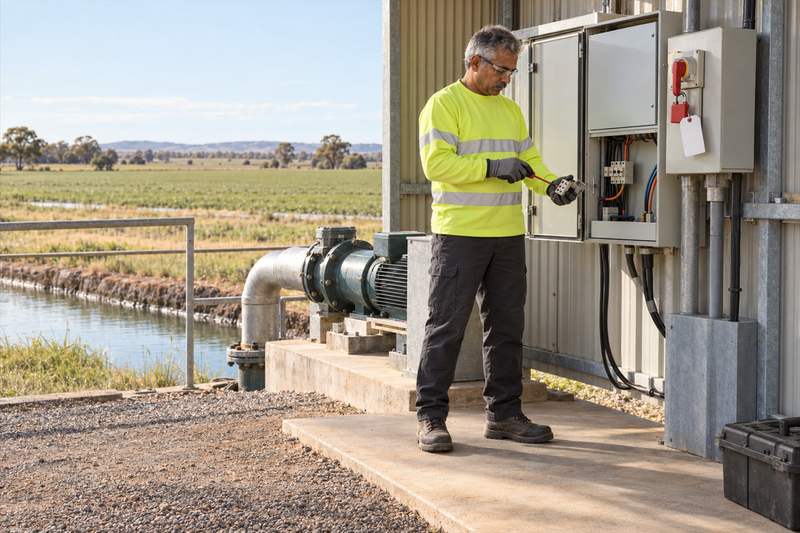
Electricians design, assemble, install, test, commission, diagnose, maintain and repair electrical networks, systems, circuits, equipment, components, appliances and facilities for industrial, commercial and domestic purposes.5 In a regional role one electrician can cover several of these, from switchboards, pumps and motors to solar systems and fault-finding on plant.
The national trade qualification is UEE30820 Certificate III in Electrotechnology Electrician.6 The qualification alone doesn't allow someone to work: each state and territory licenses electrical work, and the licence is what you check before an offer.
Every state and territory requires an individual licence for electrical work, though the names differ. Contractors running the business hold a separate contractor licence or registration.
Licence an individual needs to carry out electrical work, by state and territory, as published by each regulator on 1 November 2026.
| State or territory | Licence an electrician needs | Good to know |
|---|---|---|
| Queensland | Electrical mechanic licence, an open licence for all electrical work7 | Restricted licences cover limited electrical work by other trades7 |
| New South Wales | A licence or certificate for any electrical wiring work, whatever its cost8 | Equipment in or around a mine sits outside the definition of an electrical installation8 |
| Victoria | Electrician's licence (A Grade)9 | Contractors register separately as Registered Electrical Contractors9 |
| South Australia | Registration as an electrician for anyone doing the physical work10 | The business also needs a plumbing, gas fitting and electrical contractor licence10 |
| Western Australia | A licence from the Electrical Licensing Board for any work above 50 volts AC or 120 volts DC11 | Licensing is under the Electricity (Licensing) Regulations 199111 |
| Tasmania | Electrical practitioner licence (electrician), including for employees12 | Cable jointer and line worker are separate practitioner licences12 |
| Northern Territory | Unrestricted electrical mechanic licence13 | Equivalent to an electrical mechanic grade A licence13 |
| Australian Capital Territory | Unrestricted electrician licence for electrical wiring work without supervision14 | A permit allows supervised wiring work while gaining experience14 |
Where the Electrical, Electronic and Communications Contracting Award 2020 covers the role, a licensed electrician (Electrical worker grade 5) must be paid at least $1,223.11 a week, or $32.19 an hour, from 1 July 2026, including the industry, tool and electrician's licence allowances.15 The award covers employers in the electrical contracting industry.16 An electrician employed by a manufacturer or a power company usually falls under that industry's award instead, such as the Manufacturing and Associated Industries and Occupations Award 2020 or the Electrical Power Industry Award 2020.17,18
Market pay sits well above the award. Electricians had median full-time earnings of $2,191 a week, or $55 an hour, in May 2025, nationally, against $1,852 a week for all occupations.19 No regional pay series exists for the trade, so we talk with you about the rate, allowances, rosters and housing that will compete for your location.
Queensland, New South Wales and Western Australia carry most electrician job ads. Across Australia, ads rose from 2,919 to 3,323 a month in the year to September 2026, while all job ads moved from 220,338 to 222,402.2 Regional ads for electricians rose from 1,006 to 1,025 over the same year.3
Online job ads for electricians by state (three-month average to September 2026 and a year earlier) and each state's share of the trade's employment (February 2026).2,19
Start with the work: domestic, commercial, industrial, mining or a mix, and whether the electrician installs, maintains or fault-finds. Tell us the licence your state requires and any extra ticket the site expects, such as high-voltage switching, hazardous areas or instrumentation.
Then the practical terms that decide who applies: the roster, whether there is on-call work, the travel between sites, a vehicle and tools, and the rate and allowances you can offer.
You make the hiring decision and employ the person directly. We handle the search and the organising in between.
Tell us whether the role is residential, fly-in fly-out or drive-in drive-out, its point of hire and its roster, including any on-call work. We set out the roster, travel time and accommodation plainly in the first conversation.
We start with electricians who already live in or near your region, then widen the search to people ready to move. An electrician licensed in another state may need your state's licence before starting, so we raise it early. Tell us about relocation support, housing or a vehicle, and we will put it in front of candidates.
If the right person needs a visa or sponsorship, our sister business Australian Immigration Agency can advise.
Register with Hire Australia and tell us your licence, where it was issued, the work you do and where you would like to live. We will talk with you about regional electrical roles that fit.
Tell us the role, the location and when you need the electrician to start.
Employers pay nothing until the successful candidate has started and stayed two months. Candidates never pay for recruitment.
A FEW PRACTICAL QUESTIONS
Yes. Every state and territory licenses individual electrical work. New South Wales requires a licence or certificate for any electrical wiring work whatever its cost, and Tasmania requires a practitioner licence even for employees.8,12 Hire Australia asks candidates which licence they hold and where it was issued, and raises any transfer early.
Where the Electrical, Electronic and Communications Contracting Award 2020 covers the role, a licensed electrician must be paid at least $1,223.11 a week, or $32.19 an hour, from 1 July 2026, including allowances.15 Median full-time earnings were higher at $2,191 a week in May 2025.19 Hire Australia talks through your rate before the search begins.
Electrician (General) is rated in national shortage for 2026,1 and online ads for electricians rose to 3,323 a month in the three months to September 2026, 1,025 of them for regional areas.2,3 Hire Australia plans regional electrician searches around your start date and starts with people who know your area.
Hire Australia asks electricians whether they are open to moving and explains the roster, travel, housing and relocation support you offer. We also raise licensing before an offer, because an electrician from another state may need to apply for your state's licence before starting work.
Employers pay nothing until the successful candidate has started and stayed two months. Candidates never pay for recruitment. You employ the person directly, and we agree the terms with you in writing before the search begins. The fee terms are the same whether Hire Australia recruits a maintenance electrician for a mine or a service electrician for a country town.
No. Hire Australia recruits people you employ directly, in permanent roles. We don’t supply labour hire or temps, and candidates never work on our payroll. We search for and screen people for your vacancy, introduce the ones who fit, and you make the offer and employ them. That keeps the working relationship between you and your new employee from day one.