
Regional Queensland
Regional recruitment specialist for Queensland employers, from Cairns to Toowoomba and Mount Isa. See how hard each region is to hire in, and how we help.
Hire Australia is a regional recruitment specialist. We help councils, consultancies, contractors and utilities across Australia hire civil engineers, from graduates to senior and principal engineers. We build the state's registration rules, the supervision a graduate needs and the realities of a regional posting into every search.
Civil engineers are rated in shortage, and job ads for them are up on a year ago. Planning the search early helps.
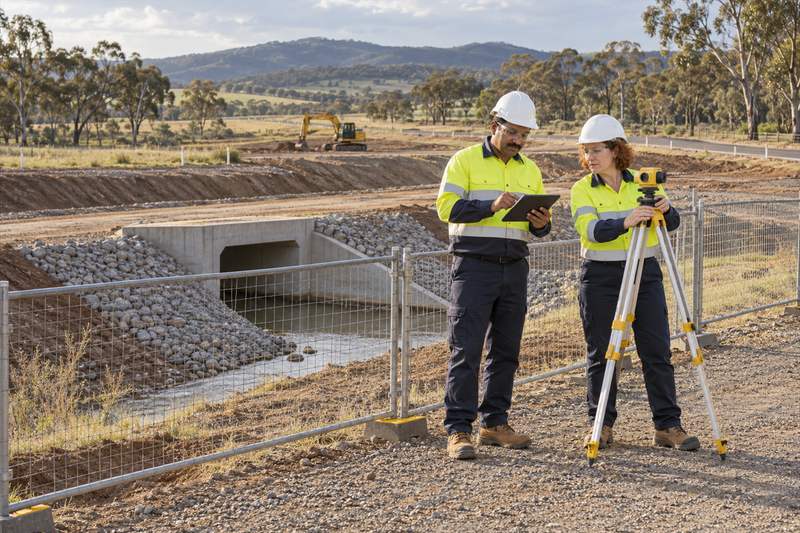
Civil engineers plan, design, organise and oversee the construction and operation of dams, bridges, pipelines, gas and water supply schemes, sewerage systems, airports and other civil projects.4 In regional areas that usually means roads, drainage, water and sewerage, subdivisions and the structures that go with them.
Most hold an engineering degree accredited by Engineers Australia, which accredits programs at three levels: professional engineer, engineering technologist and engineering associate.5 Registration then rests on experience. Queensland's RPEQ, for example, asks for a Washington Accord-recognised degree and at least five years' relevant experience in the past ten, four of them after graduating.6 Civil designers and technical officers who draft and model the work often hold RII50520 Diploma of Civil Construction Design.7
Registration follows the state the work is done in or for, so an engineer moving from another state may need a second registration.
Professional engineer registration for civil engineering work, by state and territory, as published by each regulator on 1 November 2026.
| State or territory | Registration for civil engineering work | Exceptions and timing |
|---|---|---|
| Queensland | Registered Professional Engineer of Queensland (RPEQ) for any professional engineering service6 | Not needed under an RPEQ's direct supervision, or for work done wholly to a prescriptive standard8 |
| Victoria | Registered professional engineer: civil is one of five prescribed areas9 | Mandatory for professional civil engineering services in or for Victoria, except under a registered professional engineer's direct supervision or done only to a prescriptive standard |
| New South Wales | Registered professional engineer (civil) for work on class 2, 3 or 9c buildings or parts10 | Unregistered engineers can work under a registered engineer's direct supervision |
| Australian Capital Territory | Registered professional engineer: civil is a prescribed area11 | Scheme in force since 6 March 2025; supervised and prescriptive-standard work excepted |
| Western Australia | Registered building engineer (civil) for building engineering work12 | Registration open since 1 July 2025; mandatory from 1 July 2027 |
| Tasmania | Building provider licence as an engineer (civil), which covers civil, structural, geotechnical and environmental engineering, for building-design work within the holder's competence13 | We confirm with you whether the role falls inside the scheme |
| Northern Territory | Building Practitioners Board registration for certifying engineers in three categories: structural, mechanical and hydraulic14; there is no civil category | Structural certification needs the structural category |
| South Australia | No registration required to practise15 | None |
Where the Professional Employees Award 2020 covers the role, the minimum for a full-time graduate with a four- or five-year degree is $68,538 a year, or $34.57 an hour, from 1 July 2026. An experienced engineer at Level 2 earns at least $78,836 a year.16 Councils whose engineers sit under a local government award, and black coal mines, fall outside it.16
Market pay runs well above the award. Civil engineering professionals, a group that also includes structural, geotechnical and transport engineers, had median full-time earnings of $2,217 a week, or $59 an hour, in May 2025, nationally.4 No regional pay series exists for the occupation, so we talk with you about the salary, allowances and housing that will compete for your location.
Queensland and New South Wales carry the most civil engineering job ads, and Western Australia has grown fastest in the past year. Across Australia ads rose from 2,110 to 2,473 a month in the year to September 2026.2 Ads placed for regional areas made up 21% of those with a location, 516 of 2,426.3
Online job ads for civil engineering professionals by state (three-month average to September 2026) and each state's share of the occupation's employment (February 2026).2,4
Open a specialisation for its shortage rating and what to put in your brief.
Engineers who design and manage roads, intersections and transport networks for councils and state agencies.
Engineers for water supply, sewerage, drainage and flood work.
Engineers who assess soil and rock and design foundations.
Civil engineers for track, corridors and rail structures.
Tell us the work first: roads, water, drainage, subdivisions, structures or a mix, and whether the person designs, manages projects or supervises construction. Then the level, from a graduate who needs an RPEQ to sign off their work to a principal who signs off others.
The practical details shape who will apply: the design and drafting software you use, the split between office and site, the size of the asset base or capital program, and how much travel the role involves across your district.
You make the hiring decision and employ the person directly. We handle the search and the organising in between.
Many civil engineers we speak with are open to a regional role when the work is varied and the move is supported. We start with engineers who already live in or have ties to your region, then widen the search to people planning a move.
Tell us early about relocation help, housing, a vehicle or a district allowance, and about any travel between depots, towns or project sites. We raise them in the first conversation, along with registration in your state for an engineer coming from interstate.
If the right person needs a visa or sponsorship, our sister business Australian Immigration Agency can advise.
Register with Hire Australia and tell us your experience, the projects you have worked on, your registration and where you would like to work. Graduate and experienced civil engineers are welcome, and we will talk with you about roles that fit.
Tell us the role, the location and your start date.
Employers pay nothing until the successful candidate has started and stayed two months. Candidates never pay for recruitment.
A FEW PRACTICAL QUESTIONS
It depends on the state. Queensland, Victoria and the ACT require registration for professional civil engineering work, NSW for work on certain apartment and public buildings, and WA from 1 July 2027 for building engineering work; South Australia has no requirement.6,9,10,11,12,15 Hire Australia builds your state's rule into the search.
Yes. A graduate civil engineer can provide professional engineering services under the direct supervision of an RPEQ, who directs and reviews the work and stays responsible for it.8 When Hire Australia briefs a graduate role, we ask who that supervising engineer will be and tell candidates, because the supervision on offer weighs heavily in their decision.
Where the Professional Employees Award 2020 covers the role, a graduate civil engineer with a four- or five-year degree earns at least $34.57 an hour from the first full pay period on or after 1 July 2026.16 The wider civil engineering professionals group's national median was $59 an hour in May 2025.4 Hire Australia talks through your salary range before the search begins.
Civil Engineer is rated in shortage for 2026,1 and online ads for civil engineering professionals rose to 2,473 a month in the three months to September 2026, 516 of them for regional areas.2,3 Hire Australia plans regional civil searches around your start date and starts with engineers who have ties to your area.
Employers pay nothing until the successful candidate has started and stayed two months. Candidates never pay for recruitment. You employ the person directly, and we agree the terms with you in writing before the search begins. The fee terms are the same whether Hire Australia recruits a graduate civil engineer or a principal engineer.
No. Hire Australia recruits people you employ directly, in permanent roles. We don’t supply labour hire or temps, and candidates never work on our payroll. We search for and screen people for your vacancy, introduce the ones who fit, and you make the offer and employ them. That keeps the working relationship between you and your new employee from day one.