
Regional Queensland
Regional recruitment specialist for Queensland employers, from Cairns to Toowoomba and Mount Isa. See how hard each region is to hire in, and how we help.
Hire Australia is a regional recruitment specialist. We help fabrication shops, mines and processing plants, structural steel and engineering contractors, and agricultural equipment makers across Australia hire boilermakers, metal fabricators, pressure welders and first class welders. We build the welding qualifications, lifting licences and site inductions your work requires into the brief.
Job ads for structural steel and welding trades workers rose sharply over the past year, led by Western Australia.
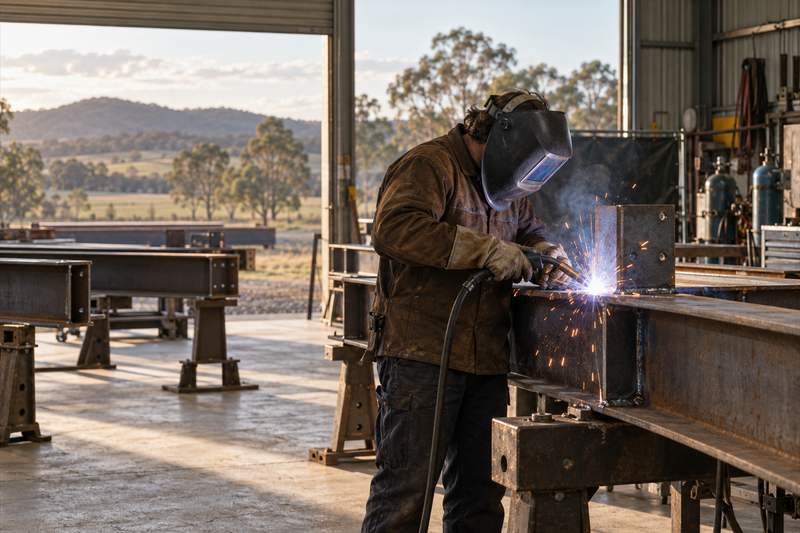
Structural steel and welding trades workers cut, shape, join and repair iron, steel and other metal structures, boilers, pressure vessels, pipes and vessels. They read blueprints, cut sections with flame torches and machines, bend metal by heating and hammering, join it by welding, bolting and riveting, and examine welds for bead width and penetration.5
The group has three occupations. Metal Fabricator, whose specialisation is boilermaker-welder, marks off and fabricates structural steel and makes or repairs products such as boilers and pressure vessels. Pressure Welder assembles, welds and repairs pressure vessels and pipes to the relevant standards, and Welder (First Class) fabricates and repairs metal products by welding, with special class welder as a specialisation.5
The national trade qualification is MEM31925 Certificate III in Engineering - Fabrication Trade, covering metal fabrication, structural steel erection, sheetmetal work, welding and surface finishing.6 Boilermakers working on a building or construction site also need the construction induction white card.7
In Western Australia, first class welders and boilermakers do not need a licence to trade.8 No licensing requirement applies to the national fabrication qualification itself, although individual units and tasks can relate to licensing.9 The table sets out the welding qualification standards and, for lifting and placing steel, the dogging and rigging licences each state's work health and safety regulator issues. You confirm the requirements and licence scope for your work and jurisdiction.
Welding standards, high-risk work licences and site credentials for boilermakers and welders, as published by each regulator or issuing body on 1 November 2026.
| Credential or state | Licence, ticket or certification | What to know |
|---|---|---|
| Trade licence | None in Western Australia for first class welders and boilermakers8 | The trade credential is MEM31925 Certificate III in Engineering - Fabrication Trade6 |
| Welder qualification | AS/NZS ISO 9606.1:2017, the current standard for qualification testing of welders in fusion welding of steels10 | Weld Australia runs welder certification against ISO 960611 |
| Australian additions | AS/NZS 2980:2018 sets extra requirements for Australian and New Zealand conditions, used with AS/NZS ISO 9606.112 | It covers qualification testing, not the certification of welders12 |
| Queensland | WorkSafe Queensland rigger licences: basic (RB), intermediate (RI) and advanced (RA)13 | Basic rigging needs a dogging licence, or a passed dogging assessment, first13 |
| New South Wales | SafeWork NSW dogging (DG) and rigging classes; basic rigging (RB) includes structural steel erection14 | The dogging class must be held before the rigging classes14 |
| Victoria | WorkSafe Victoria dogging (DG) and basic, intermediate and advanced rigging (RB, RI, RA) licences15 | Forklift (LF) and boom-type EWP (WP) are separate classes15 |
| South Australia | Licence for rigging and dogging work, assessed by a SafeWork SA accredited assessor16 | Older-style tickets and certificates of competency are no longer valid16 |
| Western Australia | WorkSafe WA classes for dogging work (DG) and rigging operations (RB, RI, RA)17 | Forklift (LF, LO) and boom-type EWP (WP) are also licensed classes17 |
| Tasmania | WorkSafe Tasmania dogging (DG) and rigging (RB, RI, RA) classes; basic rigging covers steel erection18 | A basic, intermediate or advanced rigging licence also allows dogging work18 |
| Northern Territory | NT WorkSafe dogging and rigging licence, alongside forklift and EWP classes19 | We work out with you which classes the site asks for |
| Australian Capital Territory | Dogging (DG) and basic rigging (RB) classes, issued by Access Canberra for the WorkSafe ACT Commissioner20 | Basic rigging includes dogging and structural steel erection20 |
| Mine sites | RIISS00134 Surface Mine Safety Skill Set, current on training.gov.au21 | Mines set out the inductions they need in the brief we agree with you |
In a workshop covered by the Manufacturing and Associated Industries and Occupations Award 2020, a qualified boilermaker or welder at C10, engineering/manufacturing tradesperson level I, earns at least $1,119.10 a week, or $29.45 an hour, from 1 July 2026.22 That award covers employers in manufacturing and associated industries and occupations for employees within its classifications.23 Metal and engineering construction done on site falls under the building and construction on-site award instead.24
Structural steel and welding trades workers had median full-time earnings of $1,688 a week, or $44 an hour, in May 2025, nationally.4 We settle the package with you, including any site, shutdown and shift allowances, before we approach anyone.
Western Australia now carries the most job ads for structural steel and welding trades workers, 501 a month against 355 a year earlier, with Queensland close behind.2 Nationally, regional areas held 609 of the 1,637 ads with a location.3
Online job ads for structural steel and welding trades workers by state (three-month average to September 2026 and a year earlier) and each state's share of the trade's employment (February 2026).2,4
Describe the work: workshop fabrication, structural steel erection, pressure vessels and pipework, plant repair or heavy equipment maintenance. Name the welding processes, materials and positions, any welder qualification test the work requires, and whether the person reads drawings and marks out their own jobs.
Then the site details: workshop or field work, shutdowns, the roster, travel, any dogging, rigging or EWP licence the job needs, and the inductions for the sites they will work on.
You make the hiring decision and employ the person directly. We handle the search and the organising in between.
Tell us whether the work is in the workshop or the field, such as shutdowns or structural steel jobs in other towns, and for site work whether it is residential, drive-in drive-out or fly-in fly-out, with its point of hire and roster. We set out the travel and any camp or accommodation at the start.
We begin with boilermakers and welders who already live near you, then widen the search to those willing to relocate. Tell us about housing or relocation help, and we will make it part of the offer we present.
If the right person needs a visa or sponsorship, our sister business Australian Immigration Agency can advise.
Register with Hire Australia and tell us your welding processes and qualifications, the tickets you hold, whether you prefer the workshop or the field and where you would like to work. We will talk with you about regional roles that fit.
Tell us the work, the site and when you need the person to start.
Employers pay nothing until the successful candidate has started and stayed two months. Candidates never pay for recruitment.
A FEW PRACTICAL QUESTIONS
In Western Australia, first class welders and boilermakers do not need a licence to trade.8 Specific tasks can still need high-risk work licences: lifting and placing steel can need dogging or rigging licences, and basic rigging covers structural steel erection.14 Hire Australia asks candidates about the qualifications and tickets they hold. You confirm the requirements and licence scope for your work and jurisdiction.
For fusion welding of steels, the current standard for welder qualification testing is AS/NZS ISO 9606.1, and AS/NZS 2980 adds requirements for Australian and New Zealand conditions.10,12 Weld Australia certifies welders against ISO 9606.11 Hire Australia asks candidates which tests they have passed and builds the standard your work needs into the brief.
In a workshop covered by the Manufacturing and Associated Industries and Occupations Award 2020, a C10 tradesperson earns at least $1,119.10 a week, or $29.45 an hour, from 1 July 2026.22 The median for structural steel and welding trades workers was $1,688 a week, or $44 an hour, in May 2025.4 Hire Australia agrees the package with you first.
Metal Fabricator, the occupation that includes boilermaker-welders, is rated in national shortage for 2026.1,5 Job ads rose to 1,682 a month in the three months to September 2026, 609 of them for regional areas.2,3 Hire Australia starts with tradespeople who already live near your workshop or site.
Employers pay nothing until the successful candidate has started and stayed two months. Candidates never pay for recruitment. You employ the person directly, and we agree the terms with you in writing before the search begins. The fee terms are the same whether Hire Australia recruits a workshop boilermaker or a pressure welder for a shutdown crew.
No. Hire Australia recruits people you employ directly, in permanent roles. We don’t supply labour hire or temps, and candidates never work on our payroll. We search for and screen people for your vacancy, introduce the ones who fit, and you make the offer and employ them. That keeps the working relationship between you and your new employee from day one.