
Regional Queensland
Regional recruitment specialist for Queensland employers, from Cairns to Toowoomba and Mount Isa. See how hard each region is to hire in, and how we help.
Hire Australia is a regional recruitment specialist. We help transport operators, mines, earthmoving and civil contractors, machinery dealers and councils across Australia hire qualified diesel and heavy vehicle mechanics, from workshop tradespeople to field service mechanics and leading hands. We build the certificate rules in New South Wales and Western Australia, the roster and the equipment into every search.
Diesel mechanics are in national shortage, and more than a third of located motor mechanic job ads are for regional areas.
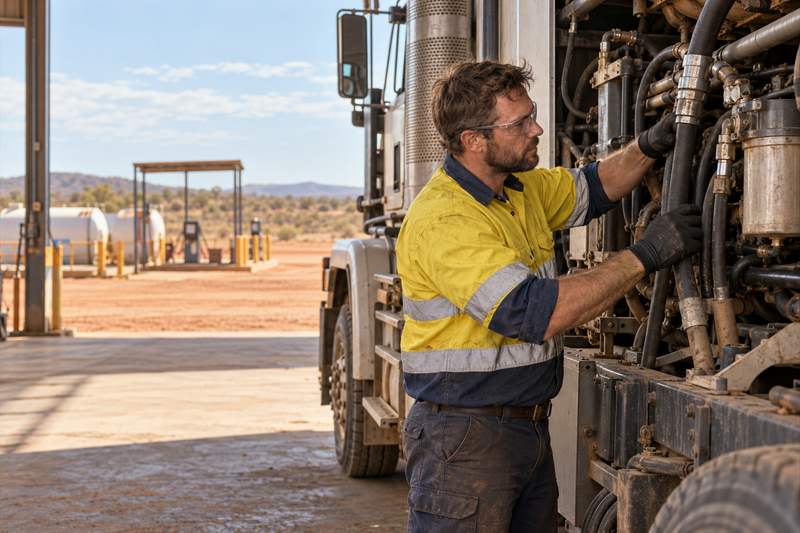
Motor mechanics, the occupation group that includes diesel specialists, detect and diagnose mechanical and electrical faults, dismantle and repair engines, transmissions and steering, and carry out scheduled servicing.5 The Vehicle Repair, Services and Retail Award 2020 describes a plant mechanic as a tradesperson repairing or overhauling wheeled, tracked or tractor-type mobile equipment used in construction, earthmoving, prime movers and agriculture.6
The national trade qualification is AUR31120 Certificate III in Heavy Commercial Vehicle Mechanical Technology.7 For a field service role, the brief usually adds a heavy vehicle driver licence and the site inductions your equipment needs.
Most states don't license mechanics as individuals. New South Wales and Western Australia do, and both have rules written for heavy vehicles.
Licence or certificate an individual needs for heavy vehicle repair work, by state and territory, as published by each regulator on 1 November 2026.
| State or territory | Licence a diesel mechanic needs | Good to know |
|---|---|---|
| New South Wales | Motor vehicle tradesperson certificate for work affecting a vehicle's mechanical operation or structure, including heavy vehicles over 4.5 tonnes8 | No certificate is needed for vehicles that can't be driven on NSW roads, such as agricultural tractors; the motor mechanic category accepts AUR31120 or AUR306208,9 |
| Western Australia | Motor vehicle repairer certificate to repair unsupervised or to supervise people without one10 | Heavy vehicle work (over 8,000 kg) and diesel work are separate classes on the certificate11 |
| Australian Capital Territory | No individual certificate; anyone who repairs motor vehicles as a business needs a licence12 | The licence attaches to the repair business |
| Queensland | No certificate for heavy vehicle mechanics; Queensland licenses motor dealers13 | None |
| Victoria | No certificate for heavy vehicle mechanics; the licence list covers motor car traders14 | None |
| South Australia | No certificate for heavy vehicle mechanics; the vehicle licence covers second-hand dealers15 | None |
| Tasmania | No certificate for heavy vehicle mechanics; motor vehicle traders are licensed instead16 | Auto gas-fitters are licensed as a separate occupation16 |
| Northern Territory | No certificate for heavy vehicle mechanics; motor vehicle dealers are licensed instead17 | None |
Where the Vehicle Repair, Services and Retail Award 2020 covers the role, a qualified diesel or heavy vehicle mechanic (tradesperson level 1) must be paid at least $1,119.10 a week, or $29.45 an hour, from 1 July 2026. A tool allowance of $13.86 a week also applies if you require the mechanic to provide their own hand tools.6,18 The award covers businesses principally connected with repairing, servicing and selling vehicles, so a mechanic employed by a mine, a manufacturer or another business with a different main activity usually falls under that industry's award.6
For market pay, the closest published figure is for the wider Motor Mechanics group, which includes light vehicle mechanics: a median of $1,622 a week, or $40 an hour, for full-time workers in May 2025, nationally.4 No separate figure exists for diesel or heavy vehicle mechanics, so we talk with you about the rate, allowances and roster that will attract them to your location.
Job ads for motor mechanics, diesel and light vehicle together, are concentrated in Queensland, New South Wales and Western Australia. Nationally they eased slightly, from 3,587 to 3,511 a month in the year to September 2026.2 Western Australia carries 22% of the group's ads but 13.2% of its workforce.2,4
Online job ads for motor mechanics by state (three-month average to September 2026 and a year earlier) and each state's share of the group's employment (February 2026).2,4
Open a specialisation for its rules and what to put in your brief.
Mechanics who keep prime movers, rigid trucks, buses and trailers on the road.
Plant mechanics for excavators, dozers, loaders, graders and mobile mining equipment.
Tell us what the mechanic will work on, from prime movers and buses to excavators, haul trucks or harvesters, and whether the work is in a workshop, in the field or both. Name the engine and equipment makes, the diagnostic software and any certificate class your state requires.
Then the terms that decide the shortlist: the roster and on-call duties, a service vehicle and the driver licence it needs, tools supplied or not, accommodation for remote work, and the rate and allowances you can offer.
You make the hiring decision and employ the person directly. We handle the search and the organising in between.
Tell us whether the role is residential, drive-in drive-out or fly-in fly-out, where the point of hire is and how the roster runs. We describe the roster, the camp or housing and the travel honestly at the start.
We start with mechanics who already live in or near your region, then widen the search to those willing to relocate or commute on a roster. Tell us about relocation help, housing or a vehicle, and we put it in front of candidates.
If the right person needs a visa or sponsorship, our sister business Australian Immigration Agency can advise.
Register with Hire Australia and tell us the equipment you work on, your certificate if your state issues one, your driver licence and the roster or town you want. We will talk with you about regional diesel roles that fit.
Tell us the equipment, the location and the roster.
Employers pay nothing until the successful candidate has started and stayed two months. Candidates never pay for recruitment.
A FEW PRACTICAL QUESTIONS
Only in some states. New South Wales requires a motor vehicle tradesperson certificate that covers heavy vehicles over 4.5 tonnes, and Western Australia a repairer certificate with a heavy vehicle work class; the ACT licenses repair businesses.8,11,12 Hire Australia checks the rule for your state before the search starts.
Where the Vehicle Repair, Services and Retail Award 2020 covers the role, a qualified diesel mechanic must be paid at least $1,119.10 a week from 1 July 2026, plus a $13.86 weekly tool allowance if they must supply their own hand tools.18 The wider Motor Mechanics group had a median of $1,622 a week in May 2025.4 Hire Australia agrees the rate and allowances with you before the search.
Diesel Motor Mechanic is rated in national shortage for 2026.1 Motor mechanic job ads averaged 3,511 a month in the three months to September 2026, and 1,212 of the located ads were for regional areas.2,3 Hire Australia starts regional diesel searches early and talks directly with mechanics who know your equipment.
Yes. Hire Australia recruits diesel and heavy vehicle mechanics for permanent roles on residential, drive-in drive-out and fly-in fly-out rosters. We set out the swing, the camp, the flights and the pay for each roster at the first conversation, before we introduce anyone, and we ask each mechanic which roster and point of hire they are open to.
Employers pay nothing until the successful candidate has started and stayed two months. Candidates never pay for recruitment. You employ the person directly, and we agree the terms with you in writing before the search begins. The fee terms are the same whether Hire Australia recruits a workshop diesel mechanic or a field service mechanic for a remote site.
No. Hire Australia recruits people you employ directly, in permanent roles. We don’t supply labour hire or temps, and candidates never work on our payroll. We search for and screen people for your vacancy, introduce the ones who fit, and you make the offer and employ them. That keeps the working relationship between you and your new employee from day one.