
Regional Queensland
Regional recruitment specialist for Queensland employers, from Cairns to Toowoomba and Mount Isa. See how hard each region is to hire in, and how we help.
Hire Australia is a regional recruitment specialist. We help network owners, line construction contractors, mines and councils across Australia hire qualified electrical linesworkers and cable jointers, from experienced line mechanics to leading hands. Line work is licensed differently in almost every state, so each search starts with the licence or authorisation your network needs.
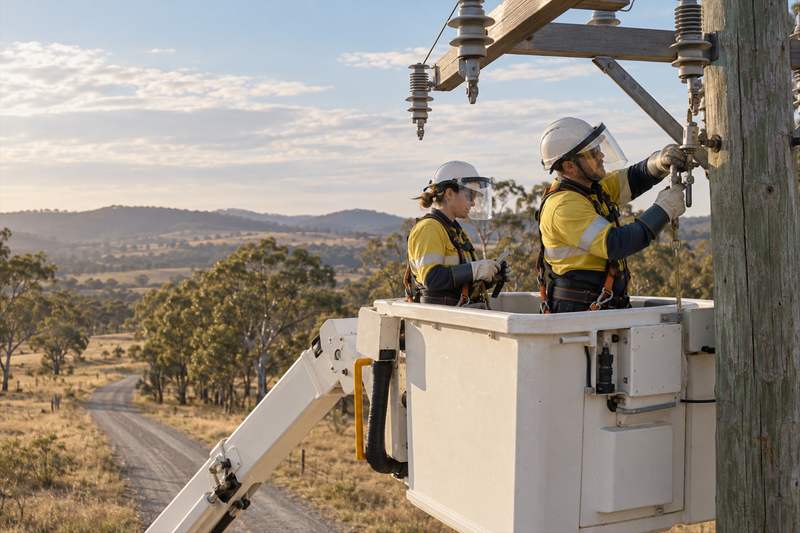
Linesworkers are a small, specialised workforce in national shortage, and a good share of the hiring happens outside the capitals.
Electrical distribution trades workers install conductors, aerial equipment and underground cables, install and maintain equipment such as transformers, attend breakdowns and emergencies, and maintain poles and associated hardware.5 In regional areas, breakdown work means call-outs and long drives between jobs.
The overhead distribution trade qualification is UET30621 Certificate III in ESI - Distribution Overhead.6 Cable jointers, transmission linesworkers and underground specialists follow their own pathways, and the licence or network authorisation is what allows them to work.
Line work is where electrical licensing differs most between states. Some issue a lineworker licence, some an endorsement, and New South Wales accredits the companies rather than licensing line work as electrical wiring.
Licence or authorisation for electrical line work, by state and territory, as published by each regulator on 1 November 2026.
| State or territory | Licence for line work | Good to know |
|---|---|---|
| Queensland | Electrical linesperson licence, covering all electric line work including overhead lines and street lighting7 | A separate electrical jointer licence covers jointing and terminating cables, such as high voltage cables7 |
| Victoria | Lineworker's licence with the class for the work: D for distribution, T for transmission, C for cable jointing or R for rail traction; licensing began on 1 January 20218 | Class D asks for a Certificate III in ESI - Distribution Overhead or its earlier equivalent8 |
| New South Wales | Supply-authority equipment sits outside the electrical licence; contestable network work is done only by accredited service providers9,10 | The scheme accredits companies, and authorisations are held with the distribution network operators10 |
| Tasmania | Electrical practitioner licence (line worker), needed even when employed11 | Cable jointer is a separate practitioner licence11 |
| Northern Territory | Electrical line work endorsement for distribution or for transmission, matching the network work12 | Each endorsement is limited to its stated network type12 |
| South Australia | Registration as an electrician for anyone doing electrical trade work; the licensing page lists no separate lineworker class13 | We confirm the network operator's requirements with you |
| Western Australia | Specified linework authorised by a major network operator and done by people trained in linework is exempt from electrical worker licensing; trained underground cable jointing has its own exemption14 | Other electrical work needs a licence from the Electrical Licensing Board, so the role's work scope decides what the person needs14,15 |
| Australian Capital Territory | The territory's construction licences include electrician classes but no lineworker class16 | Ask us to check the network operator's authorisation for the role |
Where the Electrical Power Industry Award 2020 covers the role, a tradesperson at Technical grade 3, the grade the award lists for lines and cable people, must be paid at least $1,119.90 a week, or $29.86 an hour, from 1 July 2026.17 The award covers employers that generate, transmit, distribute or retail electricity.18 A contractor building lines for a network owner may instead fall under the Electrical, Electronic and Communications Contracting Award 2020.19
Market pay is far above the award minimum. Electrical distribution trades workers had median full-time earnings of $2,731 a week, or $71 an hour, in May 2025, nationally.2 We talk through overtime, call-out and travel allowances with you before the search begins, because candidates compare the whole package.
Job ads for electrical distribution trades workers are few, 181 a month across Australia in the three months to September 2026, so each state's figure is small.3 Ads placed for regional areas made up 35% of those with a location.4
Online job ads for electrical distribution trades workers by state (three-month average to September 2026 and a year earlier) and each state's share of the group's employment (February 2026).2,3
Open a specialisation for its licence points and what to put in your brief.
Line mechanics who build and maintain the overhead poles and wires that supply towns and farms.
Specialists who joint and terminate underground and high voltage cables.
Linesworkers on the high voltage transmission lines between generators and the distribution network.
Tell us the network and the work first: distribution or transmission, overhead or underground, construction or maintenance, and the voltages involved. Then the licence or authorisation the person must hold in your state, and any switching or access permits they will need on your network.
Then the roster and travel: storm and emergency call-out, how far the crew travels, whether there is camp or motel accommodation, and the vehicle and overtime arrangements.
You make the hiring decision and employ the person directly. We handle the search and the organising in between.
Tell us the depot, the territory the crew covers, the storm and call-out roster and any time away from home. We describe each of them plainly in our first conversation with every candidate.
We start with linesworkers who already live near your depot, then widen the search to people ready to move. A linesworker from another state may need your state's licence or your network's authorisation before starting, so we raise it early.
If the right person needs a visa or sponsorship, our sister business Australian Immigration Agency can advise.
Register with Hire Australia and tell us your licence and where it was issued, the networks and voltages you have worked on, and where you would like to be based. We will talk with you about regional line work that fits.
Tell us the network, the depot location and when you need the person to start.
Employers pay nothing until the successful candidate has started and stayed two months. Candidates never pay for recruitment.
A FEW PRACTICAL QUESTIONS
Not the same one. Victoria issues lineworker licences in classes D, T, C and R, Queensland an electrical linesperson licence, Tasmania a line worker practitioner licence and the Northern Territory a distribution endorsement, while NSW accredits companies for network work.7,8,10,11,12 Hire Australia checks the rule for your state and network before the search.
Where the Electrical Power Industry Award 2020 covers the role, a tradesperson at Technical grade 3, which includes lines and cable people, must be paid at least $1,119.90 a week from 1 July 2026.17 Median full-time earnings for the group were $2,731 a week in May 2025.2 Hire Australia talks through the rate and allowances before the search begins.
Electrical Linesworker and Technical Cable Jointer are both rated in national shortage for 2026,1 and only 12,000 people work in the occupation group.2 With few job ads and a small workforce, Hire Australia plans linesworker searches early and talks directly with people who already do the work.
Yes. Cable jointers sit in the same occupation group as linesworkers, and Technical Cable Jointer is rated in national shortage for 2026.1 Queensland and Tasmania license jointers separately, so Hire Australia asks candidates which licence or class they hold and raises the role's requirements with you.7,11
Employers pay nothing until the successful candidate has started and stayed two months. Candidates never pay for recruitment. You employ the person directly, and we agree the terms with you in writing before the search begins. The fee terms are the same whether Hire Australia recruits one linesworker for a country depot or several for a network crew.
No. Hire Australia recruits people you employ directly, in permanent roles. We don’t supply labour hire or temps, and candidates never work on our payroll. We search for and screen people for your vacancy, introduce the ones who fit, and you make the offer and employ them. That keeps the working relationship between you and your new employee from day one.