
Regional Queensland
Regional recruitment specialist for Queensland employers, from Cairns to Toowoomba and Mount Isa. See how hard each region is to hire in, and how we help.
Hire Australia is a regional recruitment specialist. We help refrigeration and air conditioning contractors, food processors, cold stores, hospitals, mines and facility managers across Australia hire qualified refrigeration and air conditioning mechanics, from service technicians to commercial and industrial specialists. We build two licence questions into every brief: the national refrigerant licence and the state licence for the electrical side of the work.
Refrigeration and air conditioning mechanics are a mid-sized trade in national shortage, and job ads for them are steady on a year ago.
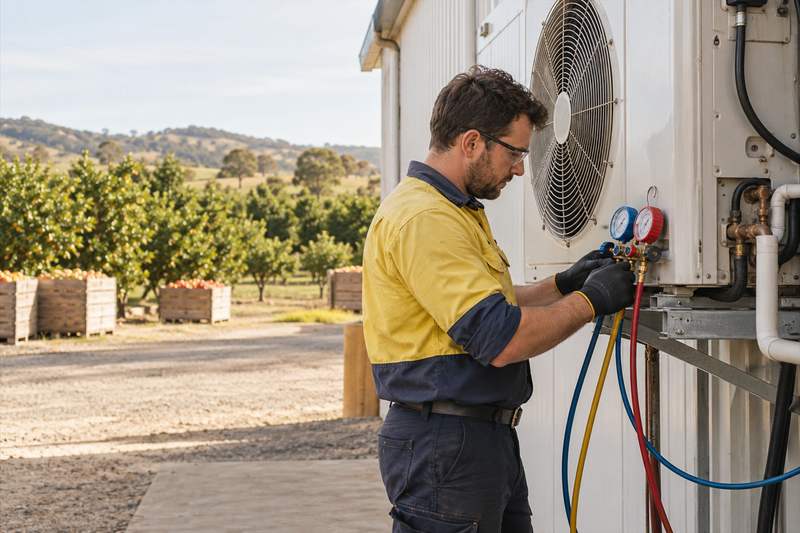
Refrigeration and air conditioning mechanics lay out installations from drawings, install and repair compressors, motors, condensers, evaporators and controls, run and braze copper lines, pressure-test systems for leaks and commission them.5 The work can range from coolrooms and process refrigeration in food plants to chillers in hospitals and split systems in homes.
The current national trade qualification is UEE32225 Certificate III in Air Conditioning and Refrigeration, which replaces the equivalent UEE32220.6 Anyone whose work risks releasing a fluorocarbon refrigerant also needs a refrigerant handling licence from the Australian Refrigeration Council.7
Two layers usually apply. The refrigerant handling licence is national and covers work with fluorocarbon refrigerants. The electrical side of the work, such as disconnecting and reconnecting equipment, needs a state licence, which in most states is a restricted electrical licence for refrigeration and air conditioning.
Licences for refrigeration and air conditioning work, by state and territory, as published by each regulator on 1 November 2026.
| State or territory | State licence for the work | Good to know |
|---|---|---|
| All states and territories | Refrigerant handling licence from the Australian Refrigeration Council for work that risks releasing a fluorocarbon refrigerant7 | RAC01 covers non-automotive refrigeration and air conditioning; work only with natural refrigerants such as hydrocarbons needs no Commonwealth licence, though state rules still apply8,9 |
| Queensland | Restricted electrical work licence, for which refrigeration and air conditioning tradespeople may be eligible10 | Mechanical services work needs an occupational licence whatever its value11 |
| New South Wales | Licence or certificate for air conditioning and refrigeration work, including the associated electrical wiring12 | Other mechanical services work needs an additional licence12 |
| Victoria | Registration or licence in the refrigerated air-conditioning plumbing class for building air conditioning work; mechanical services is a separate class for its own work13,14 | Registration in the refrigerated air-conditioning class requires a restricted electrical worker licence14 |
| South Australia | Registration for plumbing, gas fitting or electrical trade work done by the person15 | We confirm the electrical licence class for the role with you |
| Western Australia | Refrigeration and Air-Conditioning Restricted Licence for the electrical side of the work16 | One of several restricted licences in the state's framework16 |
| Tasmania | Restricted electrical work licence, refrigeration and air conditioning17 | Lets the holder disconnect, work on and reconnect equipment17 |
| Northern Territory | Restricted electrical work licence with the air-conditioning and refrigeration equipment work endorsement18 | Covers disconnecting and reconnecting fixed wired equipment18 |
| Australian Capital Territory | Restricted, Electrotechnology systems refrigeration and air-conditioning licence19 | Covers incidental wiring for disconnection and reconnection work19 |
Where the Electrical, Electronic and Communications Contracting Award 2020 covers the role, a qualified refrigeration mechanic (Electrical worker grade 5, a trade certificate in an electrical trade) must be paid at least $1,182.82 a week, or $31.13 an hour, from 1 July 2026, including the industry and tool allowances.4 That award covers electrical contractors and has a refrigeration and air-conditioning stream.20 A mechanic employed by a plumbing or mechanical services contractor may instead fall under the Plumbing and Fire Sprinklers Award 2020, which counts air conditioning plumbing as plumbing.21
Market pay is well above either minimum. Airconditioning and refrigeration mechanics, the occupation group, had median full-time earnings of $2,100 a week, or $51 an hour, in May 2025, nationally.3 We talk with you about the rate, the on-call allowance and any vehicle before the search begins.
Queensland and New South Wales carry the most ads for airconditioning and refrigeration mechanics, followed by Victoria and Western Australia. Nationally, ads held steady at 502 a month in the three months to September 2026.2 Ads placed for regional areas made up 27% of those with a location, against 29% for all job ads.22
Online job ads for airconditioning and refrigeration mechanics by state (three-month average to September 2026 and a year earlier) and each state's share of the trade's employment (February 2026).2,3
Tell us the plant: coolrooms and freezers, process or industrial refrigeration, chillers and commercial air conditioning, transport refrigeration or domestic split systems. Name the refrigerants, including any ammonia or CO2 systems, the controls and building management systems, and whether the work is installation, service or both.
Then the arrangements that decide who applies: the after-hours call-out roster, the service area and travel, a vehicle and tools, and the licences the person must hold on day one.
You make the hiring decision and employ the person directly. We handle the search and the organising in between.
Tell us the service area, the call-out roster and the vehicle. We describe each of them plainly before any candidate applies.
We start with mechanics who already live near you, then widen the search to those ready to move. A mechanic from another state keeps the national refrigerant licence but may need your state's electrical licence, so we raise it early.
If the right person needs a visa or sponsorship, our sister business Australian Immigration Agency can advise.
Register with Hire Australia and tell us the systems you work on, your refrigerant licence and state electrical licence, and where you would like to work. We will talk with you about regional roles that fit.
Tell us the plant, the location and when you need the mechanic to start.
Employers pay nothing until the successful candidate has started and stayed two months. Candidates never pay for recruitment.
A FEW PRACTICAL QUESTIONS
Usually two. Work that risks releasing a fluorocarbon refrigerant needs a refrigerant handling licence from the Australian Refrigeration Council,7 and the electrical side needs a state licence, such as a restricted licence in Western Australia or the specialist licence in New South Wales.12,16 Hire Australia asks candidates which licences they hold and builds the role's requirements into the brief.
Where the Electrical, Electronic and Communications Contracting Award 2020 covers the role, a qualified refrigeration mechanic must be paid at least $1,182.82 a week, or $31.13 an hour, from 1 July 2026.4 The median was $2,100 a week in May 2025.3 Hire Australia talks through the rate and call-out pay with you first.
Airconditioning and Refrigeration Mechanic is rated in national shortage for 2026,1 and 132 of the located job ads for airconditioning and refrigeration mechanics were for regional areas in the three months to September 2026.22 Hire Australia plans regional refrigeration searches early and talks directly with mechanics who know your type of plant.
The refrigerant handling licence is national, so it travels with the mechanic.7 The electrical licence is issued by each state, so a mechanic moving to your state may need to apply for the local restricted or specialist licence. Hire Australia raises it with candidates early, so it doesn't delay the start.
Employers pay nothing until the successful candidate has started and stayed two months. Candidates never pay for recruitment. You employ the person directly, and we agree the terms with you in writing before the search begins. The fee terms are the same whether Hire Australia recruits a domestic air conditioning technician or an industrial refrigeration mechanic.
No. Hire Australia recruits people you employ directly, in permanent roles. We don’t supply labour hire or temps, and candidates never work on our payroll. We search for and screen people for your vacancy, introduce the ones who fit, and you make the offer and employ them. That keeps the working relationship between you and your new employee from day one.