
Regional Queensland
Regional recruitment specialist for Queensland employers, from Cairns to Toowoomba and Mount Isa. See how hard each region is to hire in, and how we help.
Hire Australia is a regional recruitment specialist. We help rural merchandise and farm input businesses, growers, agribusinesses, consultancies and research groups hire agronomists, from graduates starting in a reseller branch to senior independent advisers. We build the crops, the territory and the advice model into every search.
Job ads in the wider agricultural and forestry scientists group are mostly regional, and Agronomist is rated in shortage.
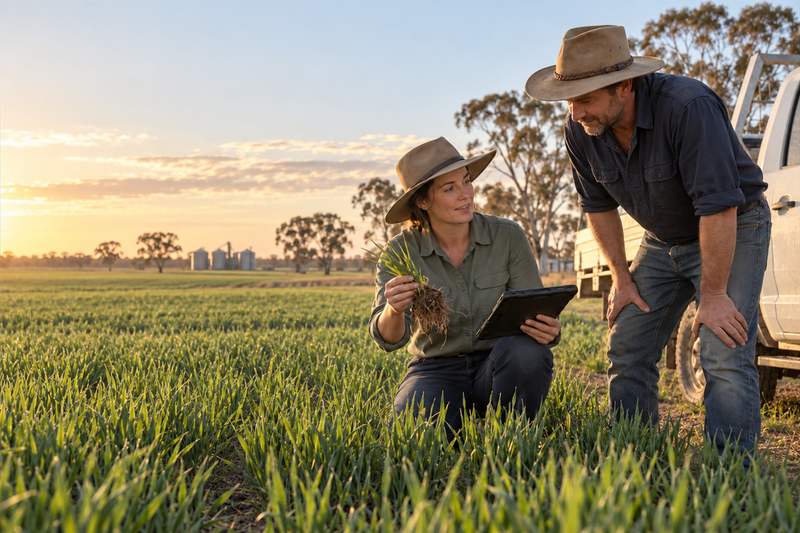
Agricultural and forestry scientists advise farmers, rural industries and government on farming, and develop techniques for increasing productivity.4 For an agronomist that means crop monitoring, soil and plant testing, nutrition and fertiliser plans, weed, pest and disease programs, and recommendations a grower can act on that week. In August 2021, 47.4% of agronomists were employed in agriculture and 26.3% in wholesale trade, which includes rural merchandise and farm input suppliers.3
Most hold a degree: in August 2021, 70.6% of agricultural and forestry scientists had a bachelor degree or higher as their highest qualification.4 Agronomists may also hold industry accreditation for fertiliser advice and chemical training, covered in the table below.
No state or territory licence is listed for agronomists. The accreditations that matter cover fertiliser advice and professional standing, and in New South Wales people who use pesticides at work have training rules to meet, subject to exemptions.
Licences, accreditations and training rules relevant to agronomists, with the body that issues or sets each. Checked 1 November 2026.
| Jurisdiction | Licence, ticket or certification | When it applies |
|---|---|---|
| All states and territories | No occupational licence or registration is listed for agronomists or agricultural consultants3 | Agronomic advice itself |
| All states and territories | Fertcare Accredited Advisor: competence to make soil and fertiliser recommendations is assessed against standards set by ASPAC, with an audit every two years5 | Advisers making soil and fertiliser recommendations |
| All states and territories | Certified Practising Agriculturalist (CPAg) from Ag Institute Australia: at least 60 professional development points over three years6 | Recognition of continuing professional development |
| New South Wales | AQF3 pesticide training (AHCCHM307 and AHCCHM304) for unsupervised users, kept current by a five-year refresher or an EPA-approved quality assurance or stewardship program7 | Using pesticides at work; exemptions apply, and licensed applicators have separate rules |
Award minimum: where the Professional Employees Award 2020 covers the role (professional scientific duties by a qualified scientist), a Level 1 scientist with a three-year degree earns at least $33.71 an hour, or $66,825 a year, from 1 July 2026.8
Market median: full-time agricultural and forestry scientists earned $57 an hour, or $2,074 a week, in May 2025. The figure is national and covers the whole group, including foresters and agricultural research scientists.4 Agronomy packages may include a vehicle, so we compare whole packages with you.
Job ads for agricultural and forestry scientists averaged 35 a month in the three months to September 2026, against 37 a year earlier, so the counts by state are small.9 Queensland holds the largest share of the group's employment.4 With so few ads, we search agronomists' networks as well as job boards.
Online job ads for agricultural and forestry scientists by state (three-month average to September 2026) and each state's share of the group's employment (February 2026).4,9
Open a role for what to put in your brief.
Agronomists based in a rural merchandise or input supplier, advising growers and selling the program.
Fee-for-service advisers who work directly for growers.
Agronomists who run trials for research groups, or manage cropping programs for a large grower.
Start with the advice model: reseller, independent, research or on-farm. Tell us the crops and enterprises, the territory and how far it ranges, whether the role carries sales targets, and the accreditations you expect, such as Fertcare.
Then the arrangements: the town base, the vehicle and phone, the busiest times of the cropping year, and the experience level, from graduate to senior adviser.
You make the hiring decision and employ the person directly. We handle the search and the organising in between.
For an agronomy role based in a country town, tell us about housing, a partner's work and schools, because the deciding questions can be about the town itself. We raise those early, explain the territory and the vehicle, and talk through the move with anyone relocating.
If the right person needs a visa or sponsorship, our sister business Australian Immigration Agency can advise.
Register with Hire Australia and tell us the crops and regions you know, the advice model you prefer, your accreditations and chemical training, and the towns you would move to. We welcome graduates and experienced agronomists.
Tell us the crops, the territory and your start date.
Employers pay nothing until the successful candidate has started and stayed two months. Candidates never pay for recruitment.
A FEW PRACTICAL QUESTIONS
No occupational licence or registration is listed for agronomists.3 Fertcare accreditation covers soil and fertiliser advice. In New South Wales, unsupervised pesticide users at work generally need AQF3 training, kept current by a five-year refresher or an approved program, with some exemptions.5,7 Hire Australia asks which accreditations your role needs.
Full-time agricultural and forestry scientists earned a national median of $57 an hour in May 2025.4 Where the Professional Employees Award 2020 covers the role, a scientist with a three-year degree earns at least $33.71 an hour from 1 July 2026.8 Hire Australia compares whole packages, including vehicles, with you.
Agronomist is rated in shortage for 2026.1 In the wider agricultural and forestry scientists group, 29 of 35 located job ads were for regional areas in the three months to September 2026.2 Hire Australia searches networks as well as ads for agronomists who know your crops.
Fertcare Accredited Advisors have their competence to make soil and fertiliser recommendations assessed against standards set by ASPAC, and are audited every two years to keep the accreditation.5 Hire Australia can search for agronomists who already hold it, or who are willing to gain it.
Employers pay nothing until the successful candidate has started and stayed two months. Candidates never pay for recruitment. You employ the person directly, and we agree the terms with you in writing before the search begins. That applies to every agronomy role Hire Australia recruits for, from graduate agronomist to senior adviser.
No. Hire Australia recruits people you employ directly, in permanent roles. We don’t supply labour hire or temps, and candidates never work on our payroll. We search for and screen people for your vacancy, introduce the ones who fit, and you make the offer and employ them. That keeps the working relationship between you and your new employee from day one.