
Regional Queensland
Regional recruitment specialist for Queensland employers, from Cairns to Toowoomba and Mount Isa. See how hard each region is to hire in, and how we help.
Hire Australia is a regional recruitment specialist. We help mines, consultancies, councils, utilities, agribusinesses and contractors hire environmental scientists, consultants, ecologists and environmental engineers, from graduates to senior advisers and approvals leads. We build the field work, the approvals and any accreditation the role needs into every search.
Environmental work is more regional than most professional jobs: well over a third of the ads are outside the major cities.
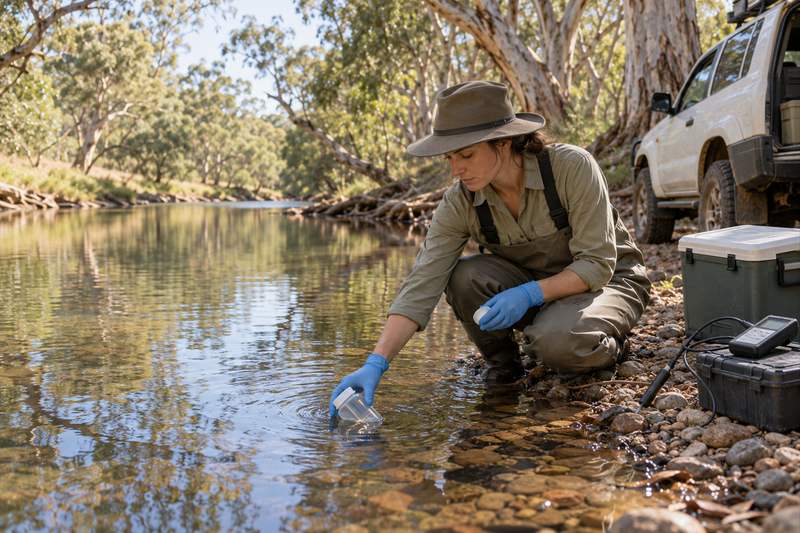
Environmental scientists study, develop, carry out and advise on plans for managing and protecting the environment, flora, fauna and other natural resources.3 In regional work that usually means environmental approvals and management plans, monitoring of water, air, noise and soil, ecological surveys, contaminated land assessment, rehabilitation and compliance reporting to the regulator.
Most hold a degree in environmental science, ecology or a related science. Environmental engineers hold an engineering degree and design treatment, remediation and containment works. Contaminated land auditors hold a state accreditation or appointment of their own.
Two schemes matter. Engineer registration applies to environmental engineers in some states, and contaminated land auditors are accredited or appointed by each state's environment regulator. Most environmental scientists need neither.
Engineer registration and contaminated land auditor schemes by state and territory, as published by each regulator on 1 November 2026.
| State or territory | Engineer registration | Contaminated land auditor accreditation |
|---|---|---|
| Queensland | RPEQ for professional engineering services4 | Accredited by the state environment department, which takes part in the national harmonised process5 |
| New South Wales | Not a listed NSW area: registration covers only civil, electrical, fire safety, geotechnical, mechanical or structural work on a class 2, 3 or 9c building or part; directly supervised staff need not register6 | Site auditors accredited by the EPA under the Contaminated Land Management Act 19977 |
| Victoria | Registration in five prescribed areas, which do not include environmental engineering8 | Environmental auditors appointed by EPA Victoria and assessed for reappointment every three years9 |
| Western Australia | Building engineer registration covers civil, structural, mechanical and fire safety only10 | Auditors accredited by the Department of Water and Environmental Regulation under the Contaminated Sites Act 200311 |
| South Australia | No engineer registration scheme12 | Accredited by the SA EPA, which takes part in the national harmonised process5 |
| Tasmania | Building provider licence as an engineer (civil), which covers civil, structural, geotechnical and environmental engineering, for building-design work within the holder's competence13 | We confirm auditor requirements with you |
| Northern Territory | No environmental category; certifying-engineer registration covers structural, mechanical and hydraulic building certification14 | We confirm auditor requirements with you |
| ACT | The ACT's prescribed areas do not include environmental engineering15 | We confirm auditor requirements with you |
Award minimum: the Professional Employees Award 2020 covers employees doing professional scientific duties, unless another award applies. A full-time Level 1 scientist with a three-year degree earns at least $66,825 a year, or $33.71 an hour, from 1 July 2026.16 In black coal mining, Environmental Scientist is a Group G staff classification with a minimum of $1,357.10 a week.17
Market median: full-time environmental scientists earned $1,953 a week, or $54 an hour, in May 2025. Environmental engineers sit in the other engineering professionals group, whose median was $2,649 a week. Both figures are national.3
Environmental scientist job ads held steady at 483 a month in the three months to September 2026, against 484 a year earlier. New South Wales, Queensland and Western Australia each had well over a hundred a month.18
Online job ads for environmental scientists by state (three-month average to September 2026) and each state's share of employment (February 2026).3,18
Open a role for what to put in your brief.
Consultants who run site assessments, approvals and remediation for clients.
Scientists for ecological surveys, monitoring programs and offsets.
Engineers for water and wastewater treatment, remediation, landfill and containment design.
Advisers who run monitoring, approvals compliance and rehabilitation at mines.
Start with the work: approvals, monitoring, ecology, contaminated land, rehabilitation or engineering design, and how much of it is field work. Tell us the regulator the role reports to, whether it needs an auditor or registered engineer, and the experience level.
Then the arrangements: the base, the field area and how remote it is, rosters or nights away, and the vehicle and equipment provided.
You make the hiring decision and employ the person directly. We handle the search and the organising in between.
Regional environmental roles can mix office days with long field trips, and mine-site roles often run on rosters. We explain the field area, the travel and the accommodation to candidates before they apply, and talk through the move with anyone relocating.
If the right person needs a visa or sponsorship, our sister business Australian Immigration Agency can advise.
Register with Hire Australia and tell us your discipline, the field and assessment work you do, any accreditation you hold, the rosters you will consider and the regions you prefer. We welcome graduates and experienced environmental professionals.
Tell us the work, the field area and your start date.
Employers pay nothing until the successful candidate has started and stayed two months. Candidates never pay for recruitment.
A FEW PRACTICAL QUESTIONS
Usually not. Contaminated land auditors are the exception: they are accredited or appointed by the state environment regulator, for example by the NSW EPA and by EPA Victoria.7,9 There is no nationally recognised auditor accreditation.5 Hire Australia confirms what your role needs before we search.
Full-time environmental scientists earned a median of $1,953 a week, or $54 an hour, in May 2025.3 Where the Professional Employees Award 2020 covers the role, a scientist with a three-year degree earns at least $33.71 an hour from 1 July 2026.16 Hire Australia compares whole packages with you, including field allowances.
More than most professional jobs. 44% of located environmental scientist job ads were for regional areas in the three months to September 2026, against 29% for all jobs.1 Hire Australia recruits environmental staff for regional employers in every state, including remote field and mine-site roles.
Yes. Environmental engineers design treatment, remediation and containment works, and the other engineering professionals group they belong to had a median of $2,649 a week in May 2025.3 In Queensland the work needs an RPEQ or an RPEQ's supervision.19 Hire Australia searches for the registration and experience your role needs.
Employers pay nothing until the successful candidate has started and stayed two months. Candidates never pay for recruitment. You employ the person directly, and we agree the terms with you in writing before the search begins. That applies to every environmental role Hire Australia recruits for, from graduate scientist to senior adviser.
No. Hire Australia recruits people you employ directly, in permanent roles. We don’t supply labour hire or temps, and candidates never work on our payroll. We search for and screen people for your vacancy, introduce the ones who fit, and you make the offer and employ them. That keeps the working relationship between you and your new employee from day one.