
Regional Queensland
Regional recruitment specialist for Queensland employers, from Cairns to Toowoomba and Mount Isa. See how hard each region is to hire in, and how we help.
Hire Australia is a regional recruitment specialist. We help pathology providers, hospital laboratories and regional health services hire medical laboratory scientists and technicians, from new graduates to senior scientists who can run a small laboratory on their own. The profession has no statutory registration, so the degree, the disciplines and the laboratory experience carry the weight in every search we run.
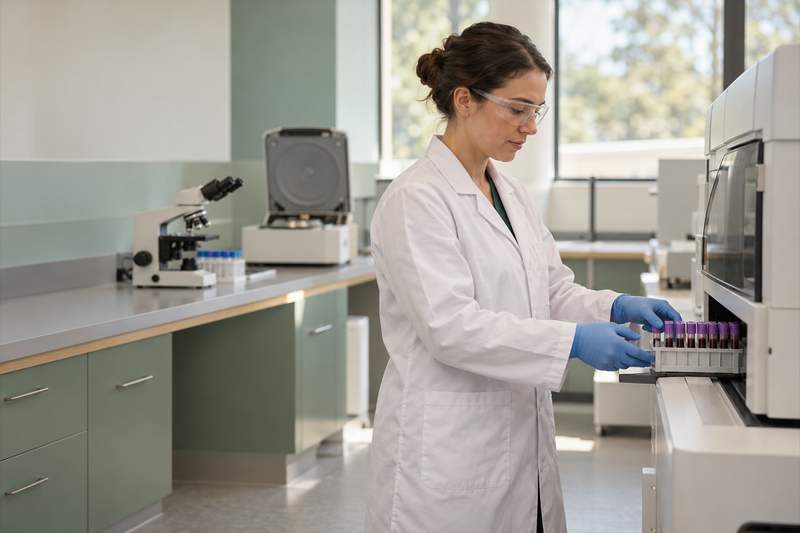
The workforce is growing, but regional laboratories compete for a small share of advertised roles.
Medical laboratory scientists conduct laboratory tests that help diagnose, treat and prevent disease. Medical laboratory technicians perform routine tests and run diagnostic equipment under the supervision of scientists and pathologists.1
The usual entry qualification for a scientist is a three or four year degree in medical laboratory science, accredited by the Australian Institute of Medical and Clinical Scientists (AIMS). For a technician it is a two-year diploma in laboratory technology (pathology testing).6 The current national diploma is MSL50122 Diploma of Laboratory Technology.7
The rules sit with the laboratory more than the scientist. To be approved as an Accredited Pathology Laboratory for Medicare, a laboratory needs a report from the National Association of Testing Authorities (NATA) recommending it, against quality standards set by the National Pathology Accreditation Advisory Council.8
No state or territory licenses medical laboratory scientists, and the profession is not one of the national boards that register health practitioners. Employers ask for the qualification and experience instead.
What a medical laboratory scientist or technician holds, and who issues it, opened 1 November 2026.
| Item | What it means for the hire |
|---|---|
| State licence or registration | No state licence, and no statutory registration or licensing of scientists or technicians anywhere in Australia6 |
| National health practitioner boards | Medical laboratory science is not one of the 15 national boards9 |
| AIMS-accredited degree | The primary qualification for a scientist; graduates can join AIMS as Graduate members6 |
| MSL50122 Diploma of Laboratory Technology | The current national diploma; AIMS treats a two-year diploma as the technician entry qualification6,7 |
| Voluntary certification | A voluntary scheme run by the Australian Council for the Certification of the Medical Laboratory Scientific Workforce6 |
| AIMS skills assessment | For overseas-trained applicants, assessed as suitable or not for ANZSCO 234611 or 3112136,10 |
| Laboratory accreditation | The employer's laboratory needs a NATA report to be approved as an Accredited Pathology Laboratory8 |
The Health Professionals and Support Services Award lists Medical Scientist at AQF level 7 and Medical Laboratory Technician at AQF level 5. Where the award covers the role, a first-year scientist earns at least $1,308.80 a week, and a first-year technician $1,232.70, from 1 October 2026.5 The award covers employers delivering health care and medical services; laboratory staff under a state public sector award fall outside it.5
The national median for medical laboratory scientists was $2,056 a week, or $56 an hour, in May 2025, for full-time employees.1 We talk with you about the salary, on-call and shift allowances, and the relocation help a regional laboratory needs to offer.
Health Professional employee Level 1, full-time minimum weekly rates by AQF level and years of experience, from the first full pay period on or after 1 October 2026.5
| Role and AQF level | 1st year a week | 4th to 6th year a week | 7th year and after a week |
|---|---|---|---|
| Medical Scientist, AQF level 7 | $1,308.805 | $1,565.30 | $1,689.50 |
| Medical Laboratory Technician, AQF level 5 | $1,232.70 | $1,426.00 | $1,541.30 |
Job ads for medical laboratory scientists averaged 106 a month in the three months to September 2026, down from 125 a year earlier. Victoria carried the most, and Western Australia's count fell from 12 to 4.3
Only 18 of the 105 ads with a location were in regional areas.4 With most ads in the major cities, a regional search may need to reach scientists working in metropolitan laboratories, so we explain the role and the move from the first approach.
Online job ads for medical laboratory scientists by state and territory, three-month average to September 2026 and a year earlier.3
| State or territory | Job ads a month, September 2026 | September 2025 |
|---|---|---|
| Victoria | 393 | 45 |
| Queensland | 21 | 22 |
| New South Wales | 20 | 23 |
| South Australia | 18 | 16 |
| Western Australia | 4 | 12 |
| Tasmania | 2 | 3 |
| Northern Territory | 1 | 1 |
| Australian Capital Territory | 1 | 3 |
Open a role for its qualification, pay and what to put in your brief.
Scientists for haematology, biochemistry, microbiology, blood bank and general laboratories.
Technicians who run routine tests and equipment under a scientist's supervision.
Experienced scientists to lead a section or a regional laboratory.
Start with the laboratory: private or public, hub or regional site, the disciplines it runs and the tests it refers away. Then the experience you need, by discipline and by analyser, and whether the person will work alone after hours.
Rosters matter in laboratory hiring. Tell us the shift pattern, the on-call load and how it is paid, the support from a hub laboratory, and the help on offer with relocation and housing.
You make the hiring decision and employ the person directly. We handle the search and the organising in between.
Most laboratory ads with a location are in major cities, so a regional search may need to reach scientists who would be moving. We start with people who live in or have ties to your region, then widen to those open to a move, and raise housing and relocation help early.
Because no state licence applies, a scientist moving between states needs no new registration; your laboratory's own requirements apply.6 If the right person needs a visa or sponsorship, our sister business Australian Immigration Agency can advise.
Register with Hire Australia and tell us your qualification, your disciplines, the analysers you know and where you would like to work. Graduate and experienced scientists and technicians are welcome, and we will talk with you about roles that fit.
Tell us the role, the laboratory, the location and your start date.
Employers pay nothing until the successful candidate has started and stayed two months. Candidates never pay for recruitment.
A FEW PRACTICAL QUESTIONS
No. There is no statutory registration or licensing of medical laboratory scientists or technicians in Australia, although a voluntary certification scheme exists.6 Employers look for an AIMS-accredited degree and relevant experience. Hire Australia builds your qualification requirements into the brief and asks each candidate for evidence, and you confirm it before an offer.
Where the Health Professionals and Support Services Award covers the role, a first-year Medical Scientist at AQF level 7 earns at least $1,308.80 a week from 1 October 2026.5 The national median for medical laboratory scientists was $2,056 a week in May 2025.1 Hire Australia talks through your range and allowances early.
Not nationally. Medical Laboratory Scientist and Medical Laboratory Technician are both rated not in shortage for 2026.2 Regional laboratories still compete for people: only 18 of 105 job ads with a location were regional.4 Hire Australia plans each regional search around your roster, location and relocation support.
It must be approved as an Accredited Pathology Laboratory, owned by an Approved Pathology Authority, with a NATA report recommending it.8 That is the laboratory's approval, not the scientist's. Hire Australia asks candidates about the accreditation and quality work they have done, which matters most for senior roles.
Employers pay nothing until the successful candidate has started and stayed two months. Candidates never pay for recruitment. You employ the person directly, and we agree the terms with you in writing before the search begins. The same terms apply whether Hire Australia recruits a graduate scientist or a laboratory lead.
No. Hire Australia recruits people you employ directly, in permanent roles. We don’t supply labour hire or temps, and candidates never work on our payroll. We search for and screen people for your vacancy, introduce the ones who fit, and you make the offer and employ them. That keeps the working relationship between you and your new employee from day one.