
Regional Queensland
Regional recruitment specialist for Queensland employers, from Cairns to Toowoomba and Mount Isa. See how hard each region is to hire in, and how we help.
Hire Australia is a regional recruitment specialist. We help public and private hospitals, birthing services and community maternity programs across regional Australia hire midwives, from graduates to experienced midwives, clinical midwife consultants and midwifery unit managers. Registration, the model of care and on-call arrangements are part of the search from the first conversation.
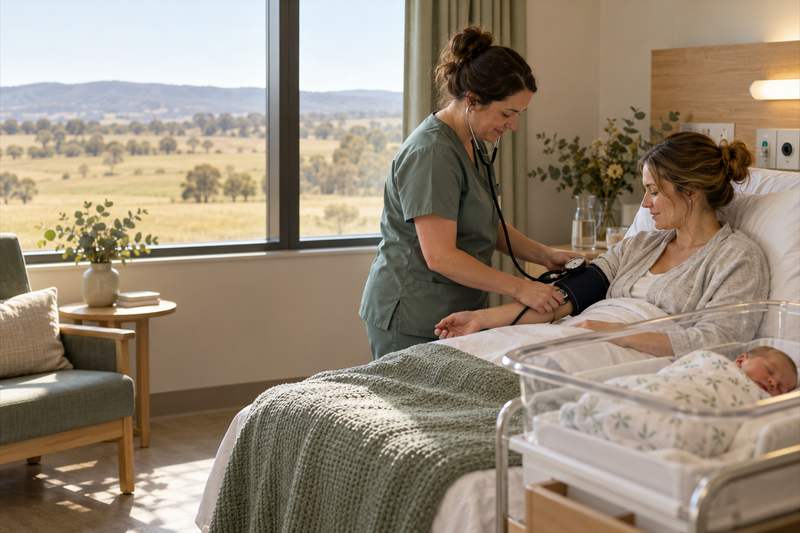
Midwives are in national shortage, and job ads for them rose sharply in the past year.
Midwives care for women through pregnancy, labour and birth, and give postnatal care to women and babies in hospitals, clinics, the community and the home.4 In a regional hospital the same midwife may cover the birth suite, the postnatal ward and antenatal clinics in one roster.
To practise, a midwife needs general registration on the national register for midwives, which is separate from the register for nurses. Ahpra keeps both for the Nursing and Midwifery Board. Some people hold registration as both a nurse and a midwife.5 An endorsement for scheduled medicines identifies midwives qualified to prescribe schedule 2, 3, 4 and 8 medicines for midwifery practice, under the law of their state or territory.5,6
Registration is national, so a midwife moving from another state needs no second registration. Checks for work with children are set by each state and territory, which decides who needs one and any exemptions, so confirm the rule for your service with the issuer.
Registration for midwives, and the check for work with children issued in each state and territory, as published by each issuer on 1 November 2026.
| State or territory | Midwife registration | Check for work with children, and issuer |
|---|---|---|
| All states and territories | General registration on the national register for midwives; one registration covers every state5 | Set by each state, as below |
| New South Wales | National registration, as above | Working with Children Check, Office of the Children's Guardian7 |
| Victoria | National registration, as above | Working with Children Check, Victorian Government8 |
| Queensland | National registration, as above | Blue card (working with children check), Queensland Government9 |
| South Australia | National registration, as above | Working with Children Check, Department of Human Services10 |
| Western Australia | National registration, as above | Working with Children Check, Department of Communities11 |
| Tasmania | National registration, as above | Registration to work with vulnerable people, Department of Justice12 |
| Northern Territory | National registration, as above | Working with Children Clearance (Ochre Card), Northern Territory Government13 |
| Australian Capital Territory | National registration, as above | Working with Vulnerable People registration, Access Canberra14 |
The Nurses Award 2020 covers midwives as well as nurses: its definition of nursing care includes care provided by midwives.15 Where the award covers the role, a midwife on registered nurse level 1, pay point 1 earns at least $1,219.50 a week, or $32.09 an hour, from 1 July 2026, and level 1 reaches $1,465.50 at pay point 8.15
Public hospital midwives are paid under their state's own instrument covering nurses and midwives. New South Wales applies the Public Health System Nurses' and Midwives' (State) Award 2025, with a 3% rise from 1 July 2026.16 Queensland Health uses its EB12 certified agreement for nurses and midwives,17 Victoria a public sector agreement for nurses and midwives running to 2028,18 and Western Australia its 2024 agreement for registered nurses and midwives.19
Midwives had median full-time earnings of $2,114 a week, or $56 an hour, in May 2025, nationally.4 No regional pay series exists for the occupation, so we talk with you about the rate, on-call payments, allowances and housing that will compete for your location.
New South Wales carries the most midwife job ads, and its ads rose most in the year, from 53 to 90 a month. Across Australia, ads rose from 205 to 275 a month in the year to September 2026.2 Ads for regional areas rose from 70 to 77 a month.3
The numbers are small, so a single rural maternity unit recruiting can move a state's count.
Online job ads for midwives by state (three-month average to September 2026 and a year earlier) and each state's share of midwives employed (February 2026).2,4
Tell us about the service first: the number of births each year, the model of care (standard care, midwifery group practice, caseload or continuity of care), and whether the role covers the birth suite, antenatal and postnatal care or all three. Then the level, from a graduate who needs support to a clinical midwife or unit manager.
The practical details shape who will apply: on-call and recall arrangements, night duty, neonatal resuscitation or theatre skills, whether the role needs registration as a nurse as well, any endorsement for scheduled medicines, and travel between towns or outreach clinics.
You make the hiring decision and employ the person directly. We handle the search and the organising in between.
Only 43% of midwives work full-time hours,4 so part-time and shared positions widen the field. Tell us the on-call load early. We start with midwives who already live in or have ties to your region, then widen the search to people planning a move.
Tell us early about housing, relocation costs, on-call payments and any rural or remote allowance. We raise them in the first conversation.
If the right person needs a visa or sponsorship, our sister business Australian Immigration Agency can advise.
Register with Hire Australia and tell us your registration, the models of care you have worked in and where you would like to work. Graduate and experienced midwives are welcome, and we will talk with you about roles that fit.
Tell us the role, the service, the location and the roster.
Employers pay nothing until the successful candidate has started and stayed two months. Candidates never pay for recruitment.
A FEW PRACTICAL QUESTIONS
Yes. There is a national register for nurses and a separate national register for midwives, both kept by Ahpra for the Nursing and Midwifery Board, and some people hold both registrations.5 Either registration covers every state. If your role needs both, Hire Australia includes that in the brief and asks candidates which registrations they hold.
The Nurses Award 2020 covers midwives.15 Where it applies, the minimum at registered nurse level 1, pay point 1 is $1,219.50 a week from 1 July 2026.15 Public hospitals pay under state instruments. Midwives' national median full-time pay was $2,114 a week in May 2025.4 Hire Australia talks through your pay range and on-call payments early.
Midwife is rated in shortage nationally for 2026.1 Online ads for midwives rose from 205 to 275 a month in the year to September 2026, and 77 a month were for regional areas.2,3 Hire Australia plans regional midwifery searches around your model of care, on-call load and start date.
It depends on the state or territory and the role. Each one runs its own check for work with children and sets who needs one, such as Queensland's blue card or the Northern Territory's Ochre Card.9,13 Hire Australia builds the checks into the brief and asks candidates which they hold; you complete the formal screening as the employer.
Employers pay nothing until the successful candidate has started and stayed two months. Candidates never pay for recruitment. You employ the person directly, and we agree the terms with you in writing before the search begins. The fee terms are the same whether Hire Australia recruits a graduate midwife or a midwifery unit manager.
No. Hire Australia recruits people you employ directly, in permanent roles. We don’t supply labour hire or temps, and candidates never work on our payroll. We search for and screen people for your vacancy, introduce the ones who fit, and you make the offer and employ them. That keeps the working relationship between you and your new employee from day one.