
Regional Queensland
Regional recruitment specialist for Queensland employers, from Cairns to Toowoomba and Mount Isa. See how hard each region is to hire in, and how we help.
Hire Australia is a regional recruitment specialist. We help remote health services, Aboriginal community controlled health organisations, state remote clinics, nursing posts and small rural hospitals hire remote area nurses. The medicines framework your state uses, the training your service requires and the realities of living in a remote community are part of the search from the first conversation.
There is no separate occupation code for remote area nurses, so these figures describe nurses working in remote areas and registered nurses as a whole.
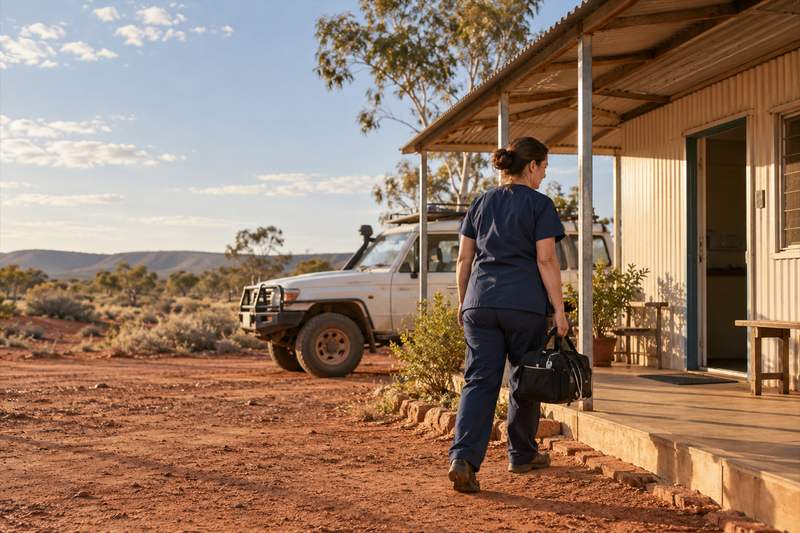
Remote area nurses provide primary health care and emergency care in communities where a doctor may not be on site. The work can include clinics, chronic disease care, child and maternal health, immunisation, emergency stabilisation and arranging retrievals, with medical advice by phone or telehealth.
A remote area nurse holds general registration as a registered nurse.8 The national endorsement for scheduled medicines in rural and isolated practice has been retired and was removed from the register on 1 February 2025. The Nursing and Midwifery Board says every state and territory now lets these nurses supply and administer certain medicines under local legislation, policies and protocols instead.9
What a remote nurse may supply or administer without a doctor's direction depends on the state or territory and on the service. Name the framework your service uses in the brief, with any course it requires.
Instruments authorising registered nurses to supply or administer medicines in remote and isolated practice, from each official page or instrument, opened on 1 November 2026. A hiring summary, not legal or clinical advice.
| State or territory | Instrument | Who authorises and key conditions |
|---|---|---|
| All states and territories | National registration as a registered nurse8 | The rural and isolated practice endorsement is retired; states and territories set the medicines rules9 |
| Queensland | Extended practice authority for registered nurses, version 7, Part B (from 1 March 2026) | Made by Queensland Health. The nurse must practise in an isolated practice area or rural hospital, have completed a relevant program of study and follow the service's approved protocol10 |
| Victoria | Secretary Approval for rural and isolated practice registered nurses (RIPRNs) | The Secretary approves the class and sites; the employer assesses and lists each nurse. Needs one of two named courses and a year in urgent, emergency, critical care or rural practice11,12 |
| Western Australia | Structured Administration and Supply Arrangement (SASA) 003/3-2024 | Issued by the CEO of Health. Covers registered nurses at the approved remote area nursing services listed, for acute treatment, where no other authorised person can attend13,14 |
| Northern Territory | PPHC Remote scheduled substance treatment protocol (in effect to 30 January 2028) | Approved by the Chief Health Officer for NT Health remote clinics. Needs registration without limiting conditions and NT Health mandatory training15 |
| Tasmania | Standing orders for persons treated in remote areas, Poisons Regulations 2018, reg 104 | Issued by a medical practitioner after committee authorisation, for emergencies in a remote area where no doctor can be present. Each order names any education requirement16 |
| New South Wales | No remote-specific instrument found in the pages we checked | Statewide ECAT protocols let nurses in specified NSW Health services who meet the education requirements initiate medicines under a Health Secretary authority17,18 |
| South Australia | No remote-specific provision found in the regulations we checked | A registered nurse may administer a drug of dependence in a health service facility under a standing order approved by the Minister (reg 50)19 |
| Australian Capital Territory | No remote-specific provision found in the regulation we checked | Standing orders at institutions, approved by a medicines and therapeutics committee, and chief health officer standing orders for walk-in centres20 |
Requirements follow the framework. Victoria names two courses, the Cunningham Centre rural and isolated practice course and a University of Southern Queensland graduate certificate.12 Queensland accepts a program the Nursing and Midwifery Board recognised before 1 February 2025 or one approved by the employing service.10 The Cunningham Centre course runs for 36 weeks online, and applicants must be working in a rural hospital or isolated practice setting.21
CRANAplus runs Remote Emergency Care and Maternity Emergency Care for remote and isolated clinicians: each is a two-day workshop with online pre-learning and a scenario-based skills assessment.22,23 Say in your brief which courses you require before the start date and which you will fund after it.
The Nurses Award 2020 has no separate remote area rate. Where it covers the role, a registered nurse earns at least $1,219.50 a week at level 1, pay point 1, $1,504.40 at level 2 and $1,631.20 at level 3, pay point 1, from 1 July 2026.3 The award's on-call allowance applies only when the employer requires a nurse at registered nurse level 1, 2 or 3 to be on call at home or another agreed place: $28.66 for each period of up to 24 hours Monday to Friday, $43.17 on a Saturday and $50.37 on a Sunday, public holiday or non-rostered day, with the whole period paid at the rate for the day holding most of it. Levels 4 and 5 are excluded.3
State and territory agreements add their own remote conditions. In Queensland Health, nurses at designated remote and very remote locations receive an annual isolation bonus at the end of each 12 months' service, from $3,695.00 after the first year from 1 April 2026; it is not paid to casual or temporary staff engaged for under 12 months, or alongside a greater locality allowance.7 WA Health nurses headquartered in districts such as the Kimberley and Pilbara can claim a district allowance.24,25 NT Health remote nurses in departmental housing in a defined remote locality receive a full rental concession.26
No earnings figure exists for remote area nurses alone. They are counted in the Registered Nurses group (ANZSCO 2544), whose national median full-time earnings were $2,192 a week in May 2025.5 We talk with you about the salary, allowances, housing and leave travel that will compete for an experienced remote nurse.
Nurses in very remote areas averaged 41.9 hours a week in 2025, against 34.6 hours across Australia.1 Registered nurse ads in Northern Australia averaged 481 a month in the three months to September 2026, and ads in the Northern Territory 127 a month.2,6 Both series count all registered nurse ads, not remote roles alone.
Nurses and midwives registered and employed, by remoteness area, 2025: headcount and average total hours a week.1
| Remoteness area | Nurses and midwives employed (2025) | Average hours a week |
|---|---|---|
| Remote (Modified Monash 6) | 4,5901 | 37.6 |
| Very remote (Modified Monash 7) | 3,072 | 41.9 |
| Australia, all areas | 421,796 | 34.6 |
Start with the community and the service: a remote clinic, a nursing post, a multipurpose service or a small hospital, the population it serves and the nearest hospital and retrieval service. Then the team: how many nurses, whether a doctor or nurse practitioner visits, and how after-hours care is shared.
Then the practical details: the medicines framework and protocol manual you use, the courses you require, whether midwifery is part of the role, any 4WD or manual vehicle driving, housing and its standard, leave travel, and cultural orientation for the community.
You make the hiring decision and employ the person directly. We handle the search and the organising in between.
We start with nurses already working in remote and rural services, then widen the search to experienced emergency, primary care and rural generalist nurses planning a move.
Tell us early about housing, relocation costs, leave travel, internet and phone coverage, and any help for a partner or family. We raise them in the first conversation, so candidates know what living in the community involves.
If the right person needs a visa or sponsorship, our sister business Australian Immigration Agency can advise.
Register with Hire Australia and tell us the remote and rural services you have worked in, your emergency and primary care experience, the courses you hold and the regions you would consider.
Tell us the community, the service, the framework you use and the start date.
Employers pay nothing until the successful candidate has started and stayed two months. Candidates never pay for recruitment.
A FEW PRACTICAL QUESTIONS
No longer. The national rural and isolated practice endorsement was retired and removed from the register on 1 February 2025. Every state and territory now sets local rules that let these nurses supply and administer certain medicines.9 Hire Australia builds your state's framework and its course requirements into the brief.
It depends on the framework. Victoria names two courses for new rural and isolated practice nurses.12 Queensland accepts a recognised program or one approved by the employing service.10 The NT remote protocol requires NT Health mandatory training, not a named course.15 Hire Australia asks candidates which courses they hold.
It depends on the employer and the agreement. Queensland Health pays an annual isolation bonus at designated remote locations, from $3,695.00 after the first year of service, with conditions.7 The Nurses Award on-call allowance applies when the employer requires a nurse below registered nurse level 4 to be on call at home or another agreed place.3 Hire Australia sets out the package in the brief.
In 2025, 4,590 nurses and midwives worked in remote areas and 3,072 in very remote areas, out of 421,796 employed nationally.1 Registered nurse ads in Northern Australia averaged 481 a month in the three months to September 2026.2 Hire Australia plans remote searches around your start date and housing.
Employers pay nothing until the successful candidate has started and stayed two months. Candidates never pay for recruitment. You employ the person directly, and we agree the terms with you in writing before the search begins. The fee terms are the same whether Hire Australia recruits a remote area nurse, a clinic team leader or a nurse for a small rural hospital.
No. Hire Australia recruits people you employ directly, in permanent roles. We don’t supply labour hire or temps, and candidates never work on our payroll. We search for and screen people for your vacancy, introduce the ones who fit, and you make the offer and employ them. That keeps the working relationship between you and your new employee from day one.