
Regional Queensland
Regional recruitment specialist for Queensland employers, from Cairns to Toowoomba and Mount Isa. See how hard each region is to hire in, and how we help.
Hire Australia is a regional recruitment specialist. We help private ambulance and patient transport operators, event and industrial medical services, health services and remote-area providers across regional Australia hire registered paramedics and intensive care paramedics. Registration, the roster and the distances involved are part of the brief from the first conversation.
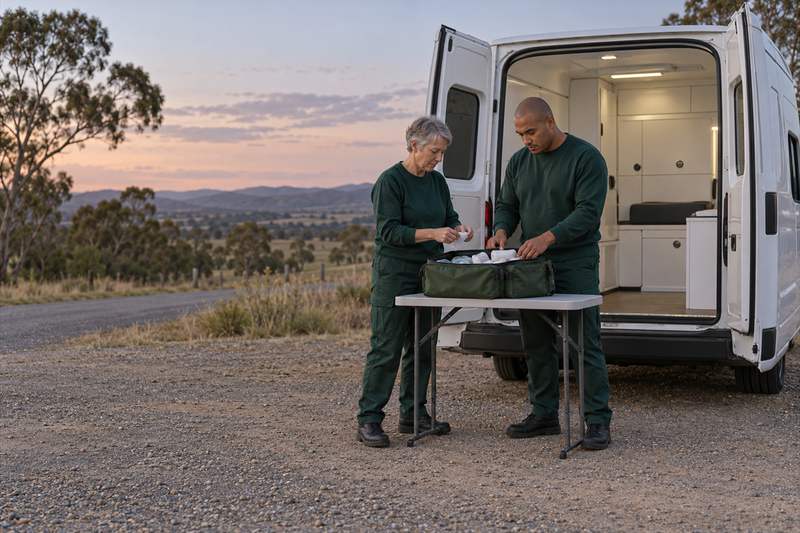
Ambulance Officer and Intensive Care Ambulance Paramedic are both rated in shortage nationally for 2026. Most of the workforce is in the eastern states, so roles elsewhere may need someone willing to move.1,2
Paramedics attend accidents, emergencies and requests for medical help and provide pre-hospital care. They assess patients, give therapies and drugs under clinical protocols, resuscitate and defibrillate, operate life-support equipment and transport patients to hospital. Intensive care paramedics provide a higher level of pre-hospital care.2
Since 1 December 2018 paramedics must be registered with the Paramedicine Board of Australia and meet its registration standards to practise. Registration is recognised in every state and territory, and registered paramedics appear on the public register.6 The employer checks the register before an offer.
Registration is national. Checks for work with children are run by each state; Queensland exempts a registered paramedic working in their professional role from the blue card.7 The ACT does not require WWVP registration where the only work with vulnerable people is in a job requiring Ahpra registration.8
Registration and each jurisdiction's check for work with children, as published by the issuers on 1 November 2026.
| State or territory | Registration | Check for work with children |
|---|---|---|
| New South Wales | General registration, Paramedicine Board of Australia6 | Working with Children Check, Office of the Children's Guardian9 |
| Victoria | General registration (national) | Working with Children Clearance10 |
| Queensland | General registration (national) | Not needed for a registered paramedic in their professional role7 |
| Western Australia | General registration (national) | Working with Children Check, Department of Communities11 |
| South Australia | General registration (national) | Working with Children Check, Department of Human Services12 |
| Tasmania | General registration (national) | Registration to Work with Vulnerable People13 |
| Northern Territory | General registration (national) | Working with Children Clearance (Ochre Card)14 |
| Australian Capital Territory | General registration (national) | Not needed where the only work with vulnerable people is in a job requiring Ahpra registration; check other duties and NDIS worker clearance8 |
The Ambulance and Patient Transport Industry Award covers employers in the ambulance and patient transport industry. It defines an Ambulance Officer or Ambulance Paramedic as holding a paramedic degree or equivalent accredited qualification, and excludes employees covered by a state public sector award.5 From 1 July 2026 the full-time minimum is $1,309.50 a week in year 1, rising to $1,326.90 in year 3.4
The national median for ambulance officers and paramedics was $2,852 a week, or $71 an hour, in May 2025.2 That median covers everyone in the group, including employees outside the award, so we benchmark each offer against the local market as well as the award.
Ambulance officer full-time minimum rates from the first full pay period on or after 1 July 2026. Paramedic skills and continuing education allowances, where they apply, are paid on top.4
| Ambulance officer | Minimum a week | Minimum an hour |
|---|---|---|
| Year 1 | $1,309.504 | $34.46 |
| Year 2 | $1,319.50 | $34.72 |
| Year 3 | $1,326.90 | $34.92 |
Online job ads for ambulance officers and paramedics averaged 60 a month in the three months to September 2026, up from 54 a year earlier. New South Wales had the most, rising from 12 to 17 a month, while Western Australia fell from 17 to 12.15
Regional ads rose from 17 to 22 a month, so regional areas account for 38% of ads with a location, against 29% for all jobs.3 The numbers are small, so a single regional vacancy can take a targeted search.
Online job ads for ambulance officers and paramedics by state and territory, three-month average to September 2026 and a year earlier.15
| State or territory | Job ads a month, September 2026 | September 2025 |
|---|---|---|
| New South Wales | 1715 | 12 |
| Victoria | 13 | 11 |
| Western Australia | 12 | 17 |
| Queensland | 11 | 8 |
| South Australia | 3 | 1 |
| Northern Territory | 2 | 2 |
| Australian Capital Territory | 2 | 1 |
| Tasmania | 1 | 1 |
Open a setting for the work, the registration and what to put in your brief.
Paramedics for private ambulance and patient transport operators.
Paramedics for event medical services, industrial sites and remote-area health.
Intensive care paramedics and senior clinicians.
You make the hiring decision and employ the person directly. We handle the search and the organising in between.
Tell us whether the role is residential, FIFO or DIDO, its point of hire and its roster, how often the person is on call, how far they drive, and whether housing is on site or in town. We put those in the brief.
We search first among paramedics who already live in or have ties to your region, then among those planning a move. Relocation help and housing support matter most in that second group. If the right person needs a visa or sponsorship, our sister business Australian Immigration Agency can advise.
Register with Hire Australia and tell us your registration, the settings and rosters you have worked, your clinical scope and where you would like to work. Graduate, experienced and intensive care paramedics are welcome, and we will talk with you about roles that fit.
Tell us the role, the setting, the roster, the location and your start date.
Employers pay nothing until the successful candidate has started and stayed two months. Candidates never pay for recruitment.
A FEW PRACTICAL QUESTIONS
Yes. Since 1 December 2018 paramedics must be registered with the Paramedicine Board of Australia to practise, and registration is recognised in every state and territory.6 Registered paramedics appear on the public register, which you check before an offer. Hire Australia builds registration into the brief and asks every candidate about it.
The Ambulance and Patient Transport Industry Award covers employers in the ambulance and patient transport industry, but not employees under a state public sector award.5 From 1 July 2026 a full-time ambulance officer earns at least $1,309.50 a week in year 1, plus any paramedic skills allowance that applies.4 Hire Australia works through the award position with you before the search.
It depends on the state and the duties. Queensland exempts a registered paramedic in their professional role from the blue card,7 and the ACT does not require WWVP registration where the only such work is in a job requiring Ahpra registration.8 Other states run their own schemes. Hire Australia raises the right check for your state with each candidate.
Yes. Ambulance Officer and Intensive Care Ambulance Paramedic are both rated in shortage nationally for 2026,1 and there were only about 60 online job ads a month for ambulance officers and paramedics nationally.15 Hire Australia starts with paramedics who have ties to your area, then reaches those planning a move.
Employers pay nothing until the successful candidate has started and stayed two months. Candidates never pay for recruitment. You employ the person directly, and we agree the terms with you in writing before the search begins. The same terms apply to every paramedic role Hire Australia recruits, from graduate paramedics to intensive care and senior clinicians.
No. Hire Australia recruits people you employ directly, in permanent roles. We don’t supply labour hire or temps, and candidates never work on our payroll. We search for and screen people for your vacancy, introduce the ones who fit, and you make the offer and employ them. That keeps the working relationship between you and your new employee from day one.