
Regional Queensland
Regional recruitment specialist for Queensland employers, from Cairns to Toowoomba and Mount Isa. See how hard each region is to hire in, and how we help.
Hire Australia is a regional recruitment specialist. We help mine operators, explorers, mining contractors, consultancies and water authorities hire geologists, geophysicists and hydrogeologists, from graduates logging core to senior resource geologists who sign off public reports. We build the commodity, the field program and the reporting responsibility into every search.
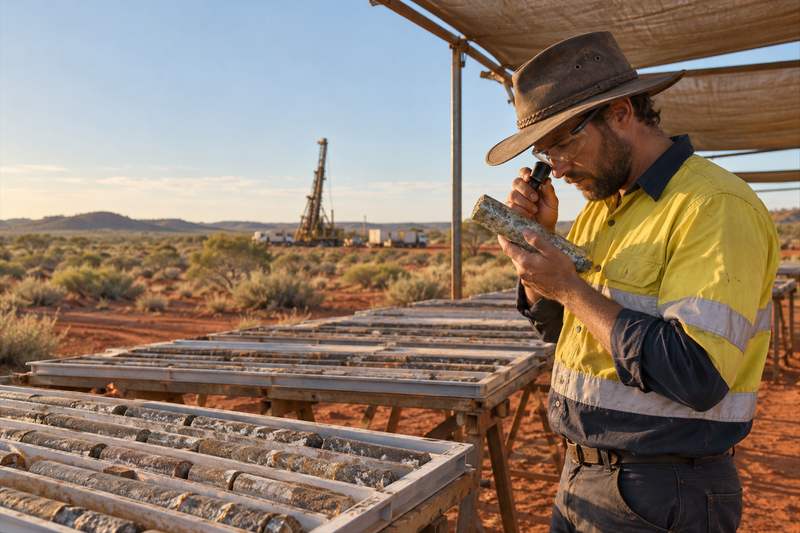
Geology is a mining profession first, a Western Australian one second, and its job ads grew fast in the year to September 2026.
Geologists, geophysicists and hydrogeologists study the composition and structure of the earth, locate and advise on the extraction of minerals, petroleum and groundwater, and monitor seismic and other earth activity.2 Most geologists work for mines: 69.2% were employed in mining in August 2021 and 18.9% in professional, scientific and technical services, which includes consultancies.4
It is a degree profession. In August 2021, 95.8% of the group held a bachelor degree or higher as their highest qualification, 41.3% a postgraduate qualification.2 Experienced geologists may also hold a professional standing, such as AusIMM Chartered Professional status, which is separate from the JORC Competent Person role.
No state or territory licence is listed for geologists or geophysicists. The standards that matter instead are the professional standing needed to report resources publicly and, at some mines, statutory appointments.
Licences, certifications and statutory roles relevant to geologists, with the body that issues or defines each. Checked 1 November 2026.
| Jurisdiction | Licence, ticket or certification | When it applies |
|---|---|---|
| All states and territories | No occupational licence or registration is listed for geologists or geophysicists4 | Geological work itself |
| All states and territories | JORC Competent Person: a Member or Fellow of AusIMM, AIG or a Recognised Professional Organisation, with at least five years' experience relevant to both the style of mineralisation or type of deposit and the reporting activity5 | Public reports of Exploration Results, Mineral Resources or Ore Reserves |
| All states and territories | AusIMM Chartered Professional (Geoscience), CP(Geo): relevant qualifications, AusIMM Member or higher standing and at least five years' relevant experience, subject to the accreditation requirements6,7 | Accreditation for experienced resources professionals |
| All states and territories | AIG Registered Professional Geoscientist (RPGeo), with professional development hours each year that may be audited8 | Recognition of continuing professional development |
| Western Australia | Exploration manager: a statutory appointment needing the applicable legislation examination, an approved WHS risk management unit and at least two years at a mine or in mining exploration9 | An exploration-only mine employing workers where no site senior executive is appointed |
Award minimum: where the Professional Employees Award 2020 covers the role (professional scientific duties by a science graduate), a Level 1 scientist with a three-year degree earns at least $33.71 an hour from 1 July 2026. Black coal is excluded from that award.10 Under the Black Coal Mining Industry Award 2020, Geologist is a Group J staff classification, with a minimum of $1,413.30 a week, or $40.38 an hour on a 35-hour week; Senior Geologist is Group K, at $1,445.20 a week.11
Market median: full-time geologists, geophysicists and hydrogeologists earned $2,914 a week, or $61 an hour, in May 2025. The figure is national and covers the whole group.2 We compare whole packages with you, including any allowances you offer.
Geology job ads rose from 177 to 248 a month in the year to September 2026, and Western Australia had 167 of them.3 Of the ads with a location, 71 of 241 were for regional areas, the same 29% share as for all jobs.12
Online job ads in the geologists and geophysicists group by state (three-month average to September 2026) and each state's share of employment for geologists, geophysicists and hydrogeologists (February 2026).2,3
Open a role for what to put in your brief.
Geologists who map, sample and drill to find and test new deposits.
Geologists for grade control, resource modelling and reconciliation on operating mines.
Specialists who survey gravity, magnetics, seismic and electrical properties to find what lies below.
Specialists in groundwater supply, mine dewatering and water impact assessment.
Start with the commodity and the stage: exploration, resource definition, grade control or closure. Tell us whether the person will sign public reports as a Competent Person, the modelling and logging software, and the experience level.
Then the arrangements: whether the role is residential, FIFO or DIDO, its point of hire and roster, the camp or town, and whether the role is office-based with field trips or fully site-based.
You make the hiring decision and employ the person directly. We handle the search and the organising in between.
Tell us whether the role is residential, FIFO or DIDO, its point of hire and its roster. We ask candidates which arrangements they will consider, and we explain the camp, travel and swing to them before they apply.
If the right person needs a visa or sponsorship, our sister business Australian Immigration Agency can advise.
Register with Hire Australia and tell us the commodities and deposit styles you know, the work you do (exploration, resource or mine geology), your professional standing, the rosters you will consider and the regions you prefer. We welcome graduates and experienced geoscientists.
Tell us the commodity, the roster and your start date.
Employers pay nothing until the successful candidate has started and stayed two months. Candidates never pay for recruitment.
A FEW PRACTICAL QUESTIONS
No occupational licence or registration is listed for geologists or geophysicists.4 Public reports of exploration results, resources or reserves must be based on documentation prepared by a JORC Competent Person, who needs AusIMM, AIG or equivalent membership and at least five years' experience relevant to both the deposit type and the reporting activity.5 Hire Australia asks whether your role carries that responsibility.
Full-time geologists, geophysicists and hydrogeologists earned a national median of $61 an hour in May 2025.2 Where the Professional Employees Award 2020 covers the role, a scientist with a three-year degree earns at least $33.71 an hour from 1 July 2026; black coal geologists are covered by their own award.10 Hire Australia compares whole packages with you.
Western Australia averaged 167 of the 248 geology job ads a month in the three months to September 2026, and holds 52.7% of the group's employment.2,3 Queensland is next on both measures. Hire Australia recruits geologists for operations and exploration programs in every state.
It is the person whose documentation public reports of exploration results, mineral resources or ore reserves must be based on. They must be a Member or Fellow of AusIMM, AIG or a recognised professional organisation, with at least five years' experience relevant to both the deposit type and the activity reported.5 Hire Australia can search for geologists who meet that standard.
Employers pay nothing until the successful candidate has started and stayed two months. Candidates never pay for recruitment. You employ the person directly, and we agree the terms with you in writing before the search begins. That applies to every geology role Hire Australia recruits for, from graduate geologist to senior resource geologist.
No. Hire Australia recruits people you employ directly, in permanent roles. We don’t supply labour hire or temps, and candidates never work on our payroll. We search for and screen people for your vacancy, introduce the ones who fit, and you make the offer and employ them. That keeps the working relationship between you and your new employee from day one.