
Regional Queensland
Regional recruitment specialist for Queensland employers, from Cairns to Toowoomba and Mount Isa. See how hard each region is to hire in, and how we help.
Hire Australia is a regional recruitment specialist. We help private dental practices, specialist practices, dental groups and community dental services across regional Australia hire qualified dental assistants, including those who take X-rays, run sterilisation or support a specialist. The qualification, your state's X-ray rules and the hours you need are part of the search from the first conversation.
Dental assistant job ads hold steady at close to 800 a month, and almost a third of them are outside the major cities.
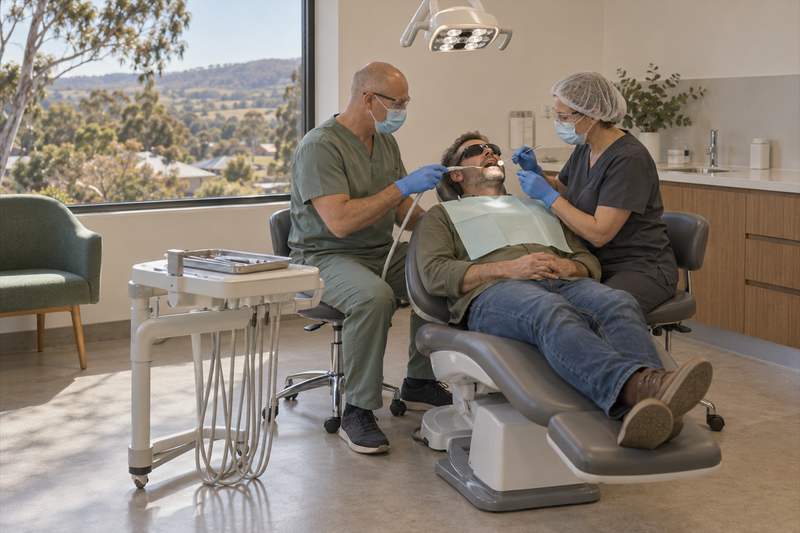
Dental assistants prepare patients, hand instruments and materials to the dentist, hygienist or therapist, use suction, process X-rays, and sterilise equipment to prevent cross-infection. Many also manage reception, billing and patient care instructions.3
Dental assistants aren't registered with the Dental Board of Australia, which registers dental practitioners only.5 The national qualifications are the HLT35021 Certificate III in Dental Assisting and the HLT45021 Certificate IV in Dental Assisting. Both are current, and the Certificate IV has a Dental Radiography specialisation.6,7 Dental Assistant isn't rated in shortage on the 2026 list.4
Taking dental X-rays is regulated by each state and territory, and the qualification states that radiography must only be done by someone licensed or authorised under that state's law.7 The rules differ sharply: New South Wales has needed no user licence since 1 December 2025 for an assistant who has completed an approved course, while Victoria and Queensland still require one.
Who may take dental X-rays as a dental assistant, as published by each state or territory regulator, read on 1 November 2026.
| State or territory | Dental X-ray rule for a dental assistant |
|---|---|
| New South Wales | No user licence for intra-oral, OPG or lateral cephalometric X-rays after an approved course (or a licence held at 1 December 2025), under general supervision8 |
| Victoria | Use licence; prerequisites are a Certificate III or IV in Dental Assisting plus the Dental Radiography Skill Set from a recognised DEN3 course provider; 3D units also need DEN4 and DEN5 training within the last 12 months9 |
| Queensland | Use licence from Queensland Health; the deemed licence covers registered dental practitioners only10 |
| Western Australia | No licence; X-rays only with an approved dental ancillary qualification, on a dentist's instructions and under supervision11 |
| South Australia | Radiation licence from the EPA to operate X-ray apparatus12 |
| Tasmania | Licence under the Radiation Protection Act 2005 to use a radiation source13 |
| Northern Territory | Licence to use intra-oral equipment after an accredited Certificate IV course that includes OPG14 |
| Australian Capital Territory | Radiation licence; training or experience such as a Certificate IV in Dental Assisting (Radiography)15 |
The Health Professionals and Support Services Award covers employers that deliver dental services, and their support services employees. Employees under a state public sector award or an enterprise award fall outside it.16 From 1 April 2026 the award set dental assistants' own levels by qualification and experience. A dental assistant with a Certificate III, or four years' experience, earns at least $1,163.90 a week, or $30.63 an hour. A Certificate IV holder earns at least $1,203.50 a week. These rates apply until 31 December 2026.16
Market pay sits a little above the award. Dental assistants had median full-time earnings of $1,211 a week, or $33 an hour, in May 2025, nationally.3 We talk with you about the rate, the hours and any relocation help that will compete for your location.
Dental assistant minimum rates, full-time, from the first full pay period on or after 1 July 2026 until 31 December 2026 (clause 16.2(b)).16
| Award level and who it covers | A week | An hour |
|---|---|---|
| Level 5: no qualification, 12 months to 4 years in dental assisting | $1,107.8016 | $29.15 |
| Level 6: Certificate III, or 4 years or more in dental assisting | $1,163.90 | $30.63 |
| Level 7: Certificate IV or equivalent experience | $1,203.50 | $31.67 |
New South Wales carries the most dental assistant job ads, ahead of Queensland and Victoria. Over the year to September 2026, ads rose in New South Wales, Western Australia, South Australia and Tasmania, and fell elsewhere, most in Queensland, from 233 to 198 a month.1 Regional ads edged up from 233 to 240 a month.2
The workforce is shrinking. 27,300 people worked as dental assistants in February 2026, 1,600 fewer than a year earlier.3
Online job ads for dental assistants by state and territory, three-month average to September 2026 and a year earlier.1
| State or territory | Job ads a month, September 2026 | September 2025 |
|---|---|---|
| New South Wales | 2191 | 199 |
| Queensland | 198 | 233 |
| Victoria | 177 | 189 |
| Western Australia | 86 | 76 |
| South Australia | 65 | 49 |
| Australian Capital Territory | 19 | 21 |
| Tasmania | 15 | 9 |
| Northern Territory | 2 | 11 |
Open a role for the qualification, the checks and what to put in your brief.
Qualified assistants for general and family dental practices.
Assistants with the radiography qualification your state requires.
Senior assistants for specialist practices, sterilisation and team leadership.
Tell us the practice first: general or specialist, how many dentists and clinicians, and the chairs the assistant will cover. Then the qualification and experience you need, and whether the role includes X-rays, sterilisation, reception or practice support.
The practical details matter just as much: the days and hours, late or Saturday sessions, the X-ray equipment on site, and any help with relocation if the right person is moving to your town.
You make the hiring decision and employ the person directly. We handle the search and the organising in between.
We start a regional dental assistant search with qualified assistants already living in your area or nearby towns, then widen it to people with ties to the region who are planning a move. Tell us the days and hours on offer, so we can match them to what each candidate is looking for.
Assistants moving interstate need to meet your state's X-ray rules before they take radiographs; Victoria, for example, issues its own use licence.9 If the right person needs a visa or sponsorship, our sister business Australian Immigration Agency can advise.
Register with Hire Australia and tell us your qualification, any radiography licence, the practices you have worked in and where you would like to work. We will talk with you about roles that fit your experience and hours.
Tell us the role, the practice, the location and the hours you need covered.
Employers pay nothing until the successful candidate has started and stayed two months. Candidates never pay for recruitment.
A FEW PRACTICAL QUESTIONS
No. The Dental Board of Australia registers dental practitioners, not dental assistants.5 Most employers look for the Certificate III or IV in Dental Assisting, and taking X-rays needs whatever licence or approved course your state requires.6,7 Hire Australia asks every candidate about their qualification and any radiography licence.
Yes, within each state's rules. New South Wales has exempted assistants who completed an approved course since 1 December 2025. Victoria and Queensland require a use licence, and Western Australia allows X-rays only with an approved dental ancillary qualification, on a dentist's instructions.8,9,10,11 Hire Australia raises your state's rule with each candidate and builds it into the brief.
Where the Health Professionals and Support Services Award covers the role, a dental assistant with a Certificate III earns at least $1,163.90 a week, and one with a Certificate IV at least $1,203.50, until 31 December 2026.16 The national median was $1,211 a week in May 2025.3 Hire Australia talks through your pay range early.
Dental Assistant isn't rated in shortage for 2026, but the workforce fell by 1,600 over the year to February 2026.3,4 Job ads averaged 782 a month in the three months to September 2026, 240 of them regional.1,2 Hire Australia starts each search with qualified assistants close to your practice.
Employers pay nothing until the successful candidate has started and stayed two months. Candidates never pay for recruitment. You employ the person directly, and we agree the terms with you in writing before the search begins. The fee terms are the same for every dental assistant role Hire Australia recruits, including lead and specialist practice assistants.
No. Hire Australia recruits people you employ directly, in permanent roles. We don’t supply labour hire or temps, and candidates never work on our payroll. We search for and screen people for your vacancy, introduce the ones who fit, and you make the offer and employ them. That keeps the working relationship between you and your new employee from day one.