
Regional Queensland
Regional recruitment specialist for Queensland employers, from Cairns to Toowoomba and Mount Isa. See how hard each region is to hire in, and how we help.
Hire Australia is a regional recruitment specialist. We help regional hospitals, private hospitals and orthopaedic practices hire orthopaedic surgeons, from surgeons who have just been admitted to fellowship to senior consultants with a subspecialty practice. Trauma on-call, theatre time and private practice rights are part of the search from the first conversation.
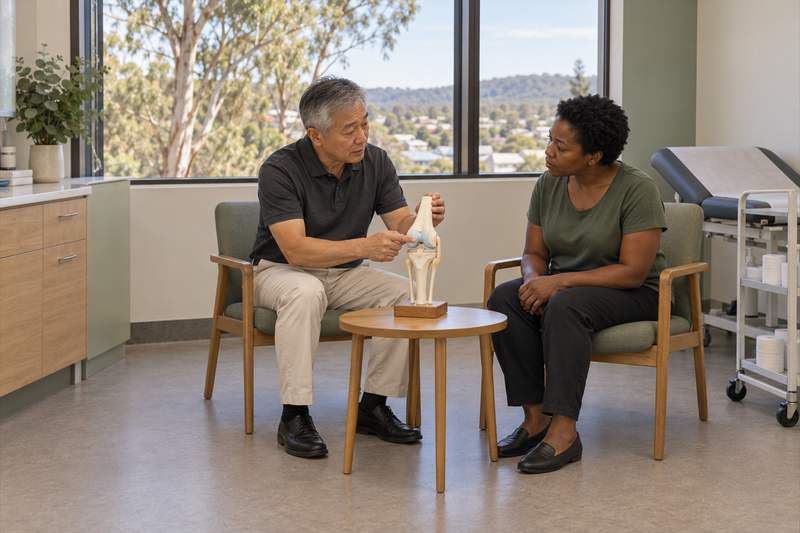
A specialty with long hours, a large share of private work and many surgeons planning to retire.
Orthopaedic surgeons perform surgery to treat muscular and skeletal diseases and injuries.3 Employers look for Fellowship of the Royal Australasian College of Surgeons in orthopaedic surgery. The Australian Orthopaedic Association runs the orthopaedic training program for the College,4 which takes approximately five years full-time and is competency based rather than time based.2
To practise as a specialist, a surgeon needs specialist registration with the Medical Board of Australia in surgery, field of orthopaedic surgery, which carries the title "specialist orthopaedic surgeon".5 Fellows of an accredited college, and doctors the college assesses as eligible for fellowship, can apply. Under the registration standard in force since 21 October 2024, an orthopaedic surgeon newly granted specialist registration needs supervised practice, an orientation to the Australian health system and cultural safety education, though some exemptions apply.6 If the surgeon was awarded an approved qualification in the specialty, they may be exempt from the six months of supervised practice, and supervised practice completed in accredited training can count towards it; a surgeon who isn't exempt may be registered with a condition to complete it.7 You can check the surgeon's current registration on Ahpra's online register.6
Medical registration is national. Using fluoroscopy or other X-ray equipment in theatre needs a radiation licence from each state's regulator, and the requirements differ between states.
Medical registration for specialist orthopaedic surgeons, and the radiation licence for using X-ray equipment such as fluoroscopy in each state and territory, as published by each regulator on 1 November 2026.
| State or territory | Medical registration | Radiation licence and regulator |
|---|---|---|
| All states and territories | Specialist registration in surgery (orthopaedic surgery) with the Medical Board of Australia; one registration covers every state6 | Set by each state, as below |
| New South Wales | National registration, as above | Radiation user licence, NSW Environment Protection Authority; a current interstate licence (other than from Queensland) can be used under automatic mutual recognition after notifying the EPA8 |
| Victoria | National registration, as above | Radiation use licence, Department of Health, Victoria, with separate forms for radiologists, cardiologists and surgeons using fluoroscopy9 |
| Queensland | National registration, as above | Use licence under the Radiation Safety Act 1999, Queensland Health, for a medical practitioner, specialist or registrar using a radiation source10 |
| South Australia | National registration, as above | Radiation licence to operate ionising radiation apparatus, Environment Protection Authority South Australia11 |
| Western Australia | National registration, as above | Licence from the Radiological Council of Western Australia; prerequisite is specialist registration12 |
| Tasmania | National registration, as above | Licence to deal with a radiation source under the Radiation Protection Act 2005, Department of Health, Tasmania13 |
| Northern Territory | National registration, as above | Radiation licence to use X-ray equipment, Northern Territory Government14 |
| Australian Capital Territory | National registration, as above | Radiation licence for medical use, ACT Health and Community Services Directorate15 |
The Medical Practitioners Award 2020 sets a floor for a specialist of $2,337.21 a week, or $121,535 a year, from 1 July 2026, where the award covers the role.16 Including the 10% on-call allowance the award pays specialists, who must be available for reasonable on-call and recall duties, the pay guide rate is $2,570.93 a week.17 Clause 4.2 limits coverage to doctors employed in settings such as hospitals, day procedure centres and community health centres, and employees under a state public sector award are excluded.16
Public hospital orthopaedic surgeons are paid under state instruments, for example the Staff Specialists (State) Award in New South Wales,18 Queensland Health's Medical Officers' Certified Agreement (No.7) 202519 and Western Australia's 2024 AMA agreement.20 With 73% of Queensland's orthopaedic surgeons in private practice,2 many roles combine a public appointment with private operating.
The wider Surgeons group, which includes registrars training as surgeons, had median full-time earnings of $3,905 a week in May 2025, nationally.3 No median exists for orthopaedic surgeons alone or for regional areas, so we talk through the base salary, private practice rights and on-call payments with you before the search starts.
Orthopaedic Surgeon is rated in shortage nationally on the 2026 list.21 Job ads for the Surgeons group averaged 75 a month in the three months to September 2026, and 33 of the 51 ads with a location were for regional areas.22,23
Northern Territory has the fewest orthopaedic surgeons for its population: 8, or 3.0 for every 100,000 residents, against 5.8 nationally. In Queensland, 21.8% of orthopaedic surgeons are located in regional Queensland.2
Doctors with specialist registration in orthopaedic surgery by principal place of practice, 30 June 2026 and 30 June 2025, and per 100,000 residents (population at 31 March 2026). Excludes registrants with no principal place of practice.
An orthopaedic surgeon billing Medicare needs specialist recognition and a Medicare provider number.26 Allow at least 6 weeks for a provider number between November and March, the government's peak processing period.27
Overseas trained specialists and foreign graduates covered by section 19AB generally need to work in a District of Workforce Shortage for 10 years from registration to access Medicare.27 Orthopaedic surgery isn't one of the eight specialties with their own ratio test, so for these surgeons the classification covers outer regional, remote and very remote areas.28 A salaried public hospital role that doesn't attract Medicare benefits has no such restriction.27
Tell us the mix of trauma and elective work, the subspecialty you need, such as joint surgery, spine, hand or paediatric orthopaedics, and whether the role is a staff specialist, visiting medical officer or private appointment.
Then the detail surgeons ask about first: the trauma on-call frequency, theatre lists and fracture clinics each week, registrar cover, access to imaging and fluoroscopy in theatre, private rooms and operating rights, and whether the role bills Medicare.
You make the hiring decision and employ the person directly. We handle the search and the organising in between.
Orthopaedic surgery is a long-hours specialty: full-time orthopaedic surgeons averaged 54 hours a week in 2021.3 A fair trauma roster shared with enough colleagues often weighs as much as the salary when a surgeon considers a regional move.
We start with surgeons who already live in or have ties to your region, then widen the search to those planning a move. Tell us early about housing, relocation costs, help establishing private rooms and support for a family, and we raise them in the first conversation.
If the right person needs a visa or sponsorship, our sister business Australian Immigration Agency can advise.
Register with Hire Australia and tell us your fellowship, subspecialty, registration and where you would like to work. We talk with you about permanent public and private roles that fit your practice.
Tell us the role, the hospital or practice, the location and the trauma roster.
Employers pay nothing until the successful candidate has started and stayed two months. Candidates never pay for recruitment.
A FEW PRACTICAL QUESTIONS
Usually, where they use fluoroscopy or other X-ray equipment. Each state licenses radiation use: Victoria has a form for surgeons using fluoroscopic X-ray units,9 and the ACT lists orthopaedic surgeons for fluoroscopy.15 Medical registration itself is national. Hire Australia asks surgeons about the licences they hold, and the employer confirms them during credentialing.
Where the Medical Practitioners Award 2020 covers the role, a specialist earns at least $2,337.21 a week from 1 July 2026, or $2,570.93 with the on-call allowance paid to specialists available for on-call and recall duties.16,17 Public hospitals pay under state instruments. The Surgeons group median was $3,905 a week in May 2025.3 Hire Australia helps you set a competitive offer.
The workforce is small and ageing. 1,644 doctors held specialist registration in orthopaedic surgery at 30 June 2026,1 and 46% of Queensland's 2022 orthopaedic workforce intended to retire by 2034.2 The occupation is rated in shortage nationally on the 2026 list.21 Hire Australia plans the search around your trauma roster and start date.
Yes, where the surgeon can become registered. Overseas-trained specialists apply to the relevant college, here the Royal Australasian College of Surgeons, for a comparability assessment on the specialist pathway.29 Hire Australia doesn't manage registration or college assessments. We raise the likely timing early so you can plan cover.
Employers pay nothing until the successful candidate has started and stayed two months. Candidates never pay for recruitment. You employ the person directly, and we agree the terms with you in writing before the search begins. The same terms apply when Hire Australia recruits an orthopaedic surgeon for a public hospital or a private practice.
No. Hire Australia recruits people you employ directly, in permanent roles. We don’t supply labour hire or temps, and candidates never work on our payroll. We search for and screen people for your vacancy, introduce the ones who fit, and you make the offer and employ them. That keeps the working relationship between you and your new employee from day one.